Homewrecker
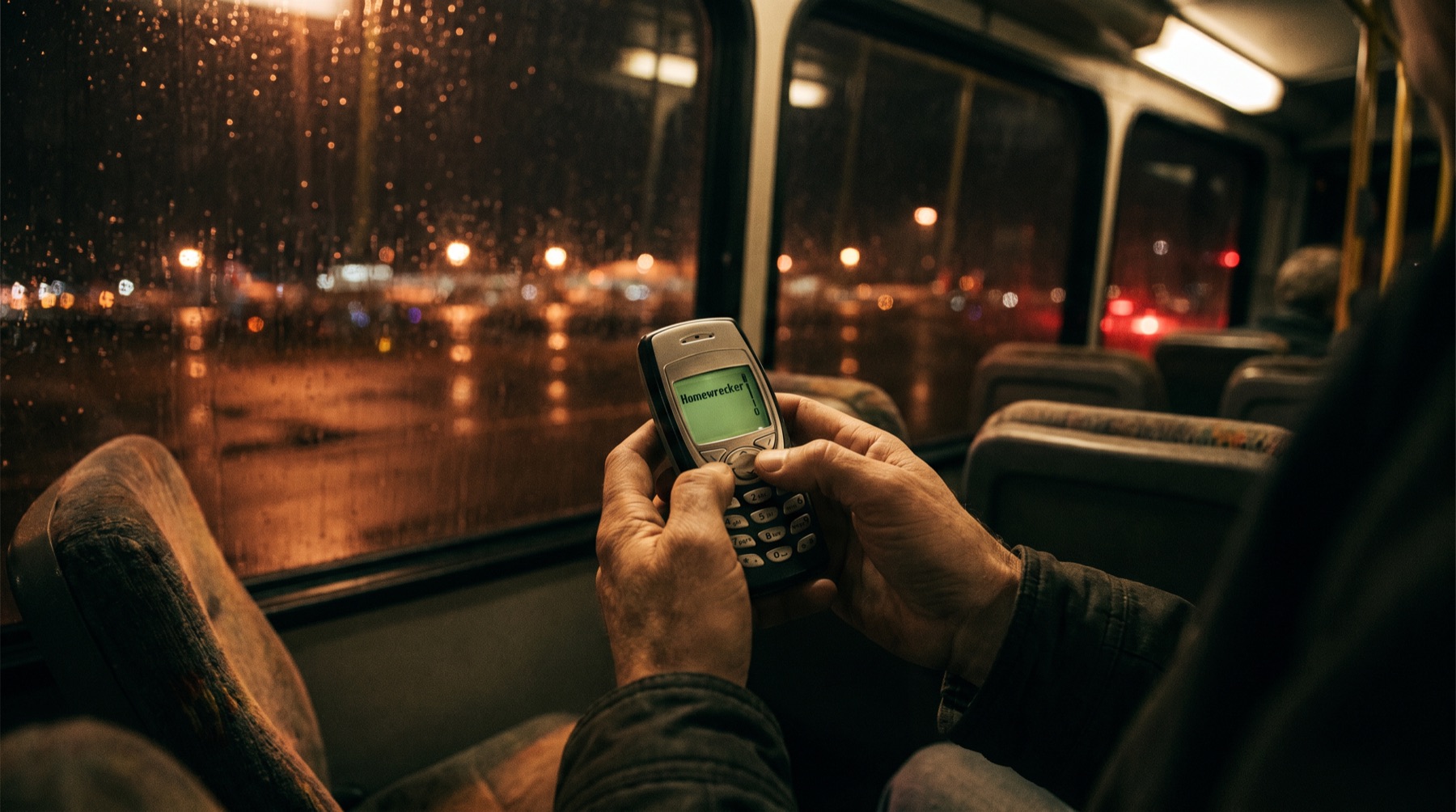
A recreation, from memory, of a story I wrote by hand on a notepad at LAX sometime in the mid-2000s and then lost. This is my best attempt to make sure it exists somewhere.
There is a particular species of waiting that only an international layover can produce, and Los Angeles International Airport has perfected it. I was flying home — Austin to Sydney, on Air New Zealand, which I recommend to anyone with nine hours to kill and a soul in need of honey ice cream. The airline was lovely. The layover was nine hours. These two facts were not related, but they had to be endured together.
For the first two hours I sat, as one does, in the terminal. And for those two hours, on a loop of roughly every ninety seconds, a recorded voice reminded me: if you see something suspicious, report it to airport personnel. First in English. Then, so that no one might miss the opportunity, in Spanish. Si ve algo sospechoso. Ninety seconds. English. Spanish. Ninety seconds.
There is a threshold — I have since learned it lives at about the two-hour mark — past which a safety announcement stops being reassuring and becomes the thing you need to be kept safe from. I could feel my own thoughts beginning to arrive in two languages. I resolved to do something else. Anything else.
The pilgrimage
I love trains. This is a fixed point in my character, load-bearing, non-negotiable. So when I discovered that a bus — the FlyAway, I think it was called, though at that stage of the day I would have boarded a vehicle called the Definitely Not A Bomb if it left the terminal — ran from the airport to Los Angeles Union Station, I went. Forty minutes. A grand old railway cathedral at the end of it. I could feel the romance of rail already warming up somewhere behind my sternum. I arrived full of expectation, the way you only can when you have spent two hours being told to be afraid.
Reader, Union Station was a soulless void.
I want to be fair to it. The wooden benches were genuinely magnificent — great burnished pews the length of a cricket pitch, the kind of furniture that has been in the background of a film. (Was it a Die Hard? I have never been able to confirm this and have chosen, over the years, not to look, because the not-knowing is nicer.) But the benches were the last survivors. Everything else — every arch, every tile, every place where romance had once lived — had been quietly evicted so that Function could move in, and Function, it turned out, wasn’t even using the space. It was the architectural equivalent of arriving at a party to find the host has left and taken the music with them.
I performed a crisp about-face. I would take the next FlyAway back to the airport and submit myself, penitent, to the Chinese water torture of the ninety-second suspicion cycle. Some pilgrimages end at the shrine. Mine ended at the timetable.
The moment
It was on the return leg that it happened.
Across the aisle sat a person with a Nokia — because this was before the iPhone, when a phone was a small hard sacrament you kept in your pocket and a text message cost real money and took real effort. And this person was doing something I had never consciously watched anyone do before. They were teaching their phone a word.
You will remember, if you are of the right vintage, T9 predictive text: the autocomplete of its day, a system that let you mash a number pad and trusted a tiny dictionary to guess which word you meant. It was autocorrect’s grandmother, and like most grandmothers it knew a great many words but not the interesting ones. And when it did not know a word, you could add it. Letter by letter. Manually. An act of some devotion. (Here is what that ritual looked like, if you never had the pleasure — or the pain.)
The word this person was adding — leaning into the little screen, jaw set, keying it in one deliberate character at a time because the machine could not imagine it unprompted — was:
homewrecker.
And my mind, which had spent the day being read its rights in two languages, came alive.
The universes
Because you don’t add a word to your phone unless you intend to use it. And more than once. You add a word because it is about to become load-bearing in your life. Somewhere, at the other end of that Nokia, a story was either beginning or ending, and this stranger on a bus was arming themselves with the vocabulary to fight it.
But which story? I had, by my own accounting at the time, roughly fifty. And here is the thing about a word that big landing in the middle of an ordinary life — the life doesn’t get bigger to meet it. The word just detonates inside the small rooms where people actually live: the Costco, the school pickup line, the dentist’s waiting room. Melodrama, in mundane clothing. Days of Our Lives, but the set is a Kia.
They came too fast to finish. That is the part I most need you to believe: I did not sit there with my chin in my hand, composing, weighing, choosing. They arrived — each one detonating under the last, half of them gone before I could turn my head to look:
The woman with the one-way ticket — three gates down from me at that very moment, for all I knew — who packed in forty minutes flat, because forty minutes is all it takes once you have finally, actually decided. Going home. Really home: the island kind, with a grandmother and a mango tree and a sea that means it. The mango tree will be told before he is.
An office kettle. A spreadsheet that somehow kept needing two people after six. A year in which nothing happened — which is exactly what makes it a wrecking and not a fling. The year.
The wife who drives past that same office at seven and sees two silhouettes in the carpark standing carefully not touching. Which is worse. Which is somehow so much worse.
The one who is leaving the country — not the relationship, the country, because the single reliable way never to wreck a home is to be too far away to reach it — and whose message, keyed in slowly, is to the wife. Who was never wronged. Who doesn’t know there was ever anything to know. I am not going to be your homewrecker. She reads it twice and blames autocorrect. The noblest and most useless text ever composed.
A wedding toast, three glasses of pinot past wisdom, opening as a tribute and curdling somewhere around the ninety-second mark — to the happy couple, and to what might have been — the DJ’s hand hovering over the fader, unsure whether mercy means cutting the music or letting it play on.
Somewhere in the middle of all this they began arriving in Spanish, because everything worthwhile at LAX arrives a second time, and the terminal had spent all day training me. I let them come. The strings swelled. Próximamente, promised a voiceover. Somebody slapped somebody by the third act. An abuela who had somehow been present at every one of these catastrophes — the airport, the carpark, the marquee — watched from a food court, seeing everything, saying nothing, filing all of it away.
The word as a screen name. The word as a password. The word taught to the phone, letter by patient letter, by the woman the whole town has been calling it behind her back — who has decided that the fastest way to take a word’s power away is to answer to it.
The neighbour’s cat, who it turns out has been dining at two houses under two different names.
And then — because the universe keeps a straight face for hours precisely so it can break it at the end — the innocent one. A fibro three-bedder on a good block, in the family since 1974, and it is finally time: knockdown, rebuild, the great suburban rite of passage. Somebody needs a demolition contractor by Friday, and homewrecker is simply the least clinical and most satisfying word for the man who turns up with an excavator and takes your childhood apart one weatherboard at a time. No affair. No abuela. No slap. His name is Héctor. He is very good. He is booked out until spring. And the only heart broken in the whole episode belongs to whoever grew up in the back bedroom.
The transmission
I got off that bus a man possessed. I located, by means I no longer recall, a notepad and a pencil — actual paper, actual graphite — and I sat down in the armpit of LAX and I wrote. All of it. The woman with the one-way ticket and the man who exiled himself, the office kettle and the ruined toast and the poor doomed weatherboards, every possible world of the homewrecker and every possible face for the stranger on the bus, in English and then in Spanish, spilling out faster than I could shape them.
I did not hear a single suspicious-baggage announcement for the next five hours. It wasn’t that they stopped. It was that I had, at last, found something more interesting than fear, and the mind — given the choice — will always leave the terminal.
When I finally set down the pencil and looked at what I’d made, flushed with the particular joy of a creative burst that has also, miraculously, eaten five hours of dead time, I noticed the one thing I’d forgotten. It had no title.
So I turned to the front page, and in careful capitals, I wrote — and underlined —
HOMEWRECKER.
And it was in that exact moment that I felt it: a person seated nearby, glancing over, clocking the word. And I watched it land. I watched the little detonation go off behind their eyes — the same one that had gone off behind mine on the bus. What had happened here? Who was the homewrecker? Was it him? Is that a confession? Should I say something? Fifty universes, cracking open in a stranger, transmitted by a single underlined word.
I like to think this was an event of some cosmic significance. That the charge did not stop there — that they carried it to the next gate, and passed it, unknowing, to someone else. That the word is still out there, chaining quietly from mind to mind in the great fluorescent purgatory of LAX, sparking small storms of speculation in people who will never know where it started.
And here is the part I like best. I don’t think it started with me either. I think whoever was on that bus, adding the word letter by letter into their Nokia, caught it from someone. And they from someone else. All the way back down the line.
Somewhere in that airport, the transmission is still going. It was going before I arrived. It will be going long after the last of us has boarded.
If you see something, the voice said, say something.
I did. This is it.