Melbourne, Florida
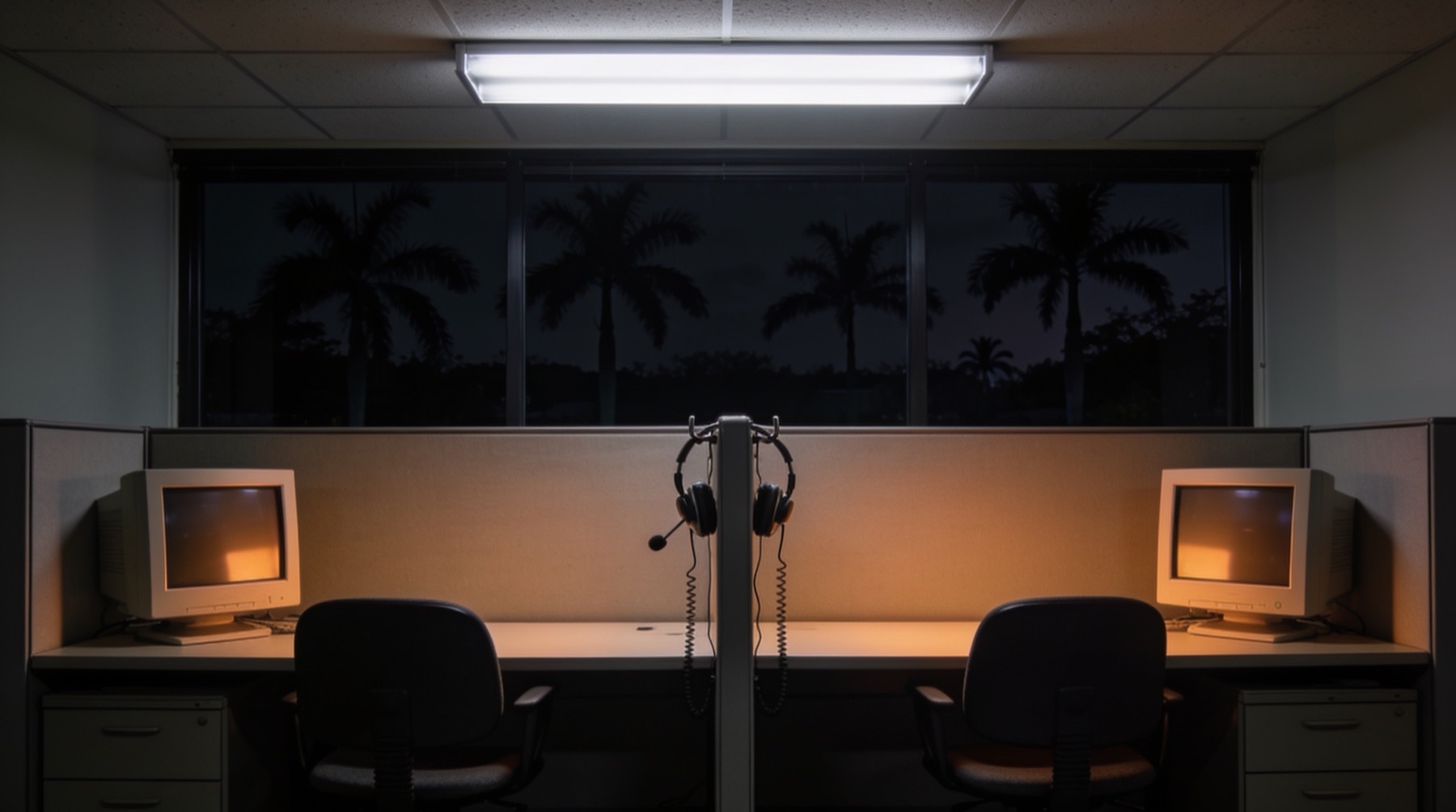
A true story from the telephone industry, composited just enough: no company, no client, no year. The arithmetic — which is the point — is exact.
In the late nineties I found myself working in Melbourne.
Not that one. The other one — Melbourne, Florida: a modest city on the Space Coast, an hour’s drive from where they launch the rockets, and sharing a name, to nobody’s benefit, with the second-largest city in my own country. For an Australian abroad this never stopped being funny, and never once was it funny to anyone else. You learn to stop mentioning it. The town was, among other things, full of call centres, and I worked in one of them.
The discovery
The company had won a piece of work that required something unusual: a Japanese-language customer support line, to be answered around the clock — which in practice meant answered through the Florida night, when it is daytime in Tokyo.
And somebody remembered that I spoke Japanese.
Which was true, in the way most résumé facts are true. I had spent a year of high school as an exchange student in Japan and come home fairly fluent — fluent, that is to say, in the Japanese of a seventeen-year-old: the register of homework, train timetables, and asking politely where the gymnasium was. This distinction, between speaks Japanese and speaks the Japanese of a diligent schoolboy, is invisible on a staffing spreadsheet. On the spreadsheet I was simply the asset closest to hand, and the asset was deployed.
The recording
So it came to pass that I wrote, and then personally recorded, the comfort messages for the queue. The genre you know even if you’ve never thought of it as a genre: your call is important to us; please continue to hold — plus the obligatory sentence advising, in the politest available Japanese, that the call might be recorded. I wrote the agents’ quality-assurance guidelines in Japanese too, and the marking criteria for scoring them, because once a company discovers it has one bilingual employee, that employee’s job description becomes everything, bilingually.
I did my best. My best contained enough mistakes that a professional was eventually engaged to re-record the lot, and my own review of my performance, delivered at the time, still strikes me as the fairest words ever spoken in that building: I probably sounded like a high school student. That’s all the Japanese I knew.
But I’ll say this in my own defence. Every “your call is important to us” ever recorded is a corporation doing an impression of sincerity. Mine was an actual human being, audibly out of his depth, genuinely trying. I maintain it was the most honest comfort message in the history of the industry. Callers would have heard a company that cared enough to try and couldn’t quite manage it — which, as a summary of the entire sector, has never been bettered.
The staffing
Then we staffed the line, and this is where the story stops being about me.
To find the two people who would actually answer it, I interviewed every Japanese speaker that corner of Florida could produce. All of them. Fifty or so human beings — students, spouses, retirees, the odd startled tourist-visa case — assessed, scored against criteria I had written in a language I spoke like a schoolboy, and whittled to the final two: the pair who would sit the graveyard shift, night after night, headsets on, certified and ready, keeping Tokyo’s office hours under a Florida moon.
Fifty interviews. Two seats. A queue built, provisioned, scripted, quality-assured and bilingually documented.
The silence
The line never received a single real call.
Not few. Not occasional. None. Ever. Two trained specialists, awake all night every night on the wrong side of the planet on purpose, and the phone did not ring.
Except once.
Once, in the whole life of the queue, the phone rang, and it was a very drunk man who had dialled a wrong number.
The missing column
I have written elsewhere — at length, in thirty programming languages, because this is apparently who I am — about Erlang C, the 1917 formula that tells you how many agents you need on the phones to meet demand. You feed it the arrival rate and the handling time, and it hands you back the staffing number and the probability a caller waits.
Feed it this queue and the formula simply looks at you.
Forecast demand: approximately zero. Staffing: two, language-certified, timezone-locked. Lifetime offered calls: one, intoxicated, misdialled. Abandonment rate: zero. Service level: one hundred per cent, by any definition, on every day the line operated. It is simultaneously the best-provisioned queue I have ever stood near and the emptiest — a system in a state of permanent, perfect readiness for a demand that had never existed and never arrived. Erlang C has no column for this. No workforce-planning tool does. There is no cell in any spreadsheet for we staffed for a phantom, beautifully.
And yet I find I can’t file it as waste. Somewhere in that building, every night, two people sat in a pool of fluorescent light being ready — and readiness, it turns out, was the entire product. Nobody ever bought it but once. Which brings me back to him.
The one caller
Think about what that man achieved. He is the only human being who ever tested the system — the entire system: the switching, the routing, the greeting, the certified bilingual staffing model, the QA framework with its lovingly translated marking criteria — and he found all of it working perfectly. Answered promptly, at three in the morning, by a trained specialist who had been waiting, in the fullest sense of the word, for months. One hundred per cent of this queue’s customers received service beyond reproach. That the customer was drunk, and wrong, and wanted someone else entirely, is recorded in no metric anywhere.
I never did establish which version of the greeting he heard while the call connected — the professional’s flawless replacement, or mine, the earnest schoolboy original, promising him in careful classroom Japanese that his call was important to us.
I know which one I hope it was. And for once, for one caller, on one night in Melbourne — the wrong Melbourne — the message was even true. His call was important to us. It was the only one we had.