Never Perth
This week a spreadsheet arrived containing sixteen years of my own flying — every flight, one row. I opened it to defend a frequent-flyer tier. It had other ideas.
There is a particular kind of person who exports his complete flight history to CSV, and I regret to inform you that I am that person, and that it gets worse from here. In my defence, there was a deadline. My airline status — the tier that determines which queue you stand in, which is to say the tier that determines everything — requires eighty status credits by the end of September, and I had nine weeks and no plan. So I pulled the full export from the flight-tracking app, intending to answer one small question: what am I working with?
What I was working with, it turned out, was a portrait.
The audit
The export said 253 flights. The app’s own front page says 247. Neither is true.
Six of the 253 never happened — cancellations, which the log dutifully preserves as scheduled non-events: flights I have technically been booked on and technically not taken, remembered forever with the same care as the real ones. That leaves 247, the official figure. But two of those are ghosts. In 2010, American Airlines and US Airways were mid-merger, and two of my flights were recorded twice — once under each flag — the same physical aeroplane, the same physical me, filed as two events by an industry that hadn’t finished deciding what it was called.
So: 245. I have flown 245 times in sixteen years, and I know this number the way you can only know a number you have argued with a spreadsheet about. The reconciliation took an evening. It was a lovely evening.
The spine
The totals are the kind of thing you quote at parties right up until you watch people’s faces: 589,401 kilometres, which is 14.7 laps of the equator, or — I checked — halfway through a second trip to the Moon. Eight hundred and fifty-two hours in the air, which is thirty-five and a half days, strapped to a seat, moving at odds with the sun.
But the totals are not the story. The story is the spine. Sydney–Adelaide: 98 sectors. Forty per cent of everything I have ever flown is the same 1,165 kilometres, back and forth, roughly five return trips a year for the better part of sixteen years. Whatever I thought my flying life was — the long-haul, the strange one-offs, Buffalo, Glasgow, Penang — the data is unmoved. My flying life was Adelaide.
Was. Because the export knows something else, and it told me flatly, the way spreadsheets do: the run has stopped. The last Adelaide sector was 23 July 2025. Nothing since. No announcement, no farewell drinks, no final walk down the airbridge with the cabin crew applauding. A route that was forty per cent of my life in the air simply ended, and I found out the way you find out about most endings — much later, from the records.
The portrait
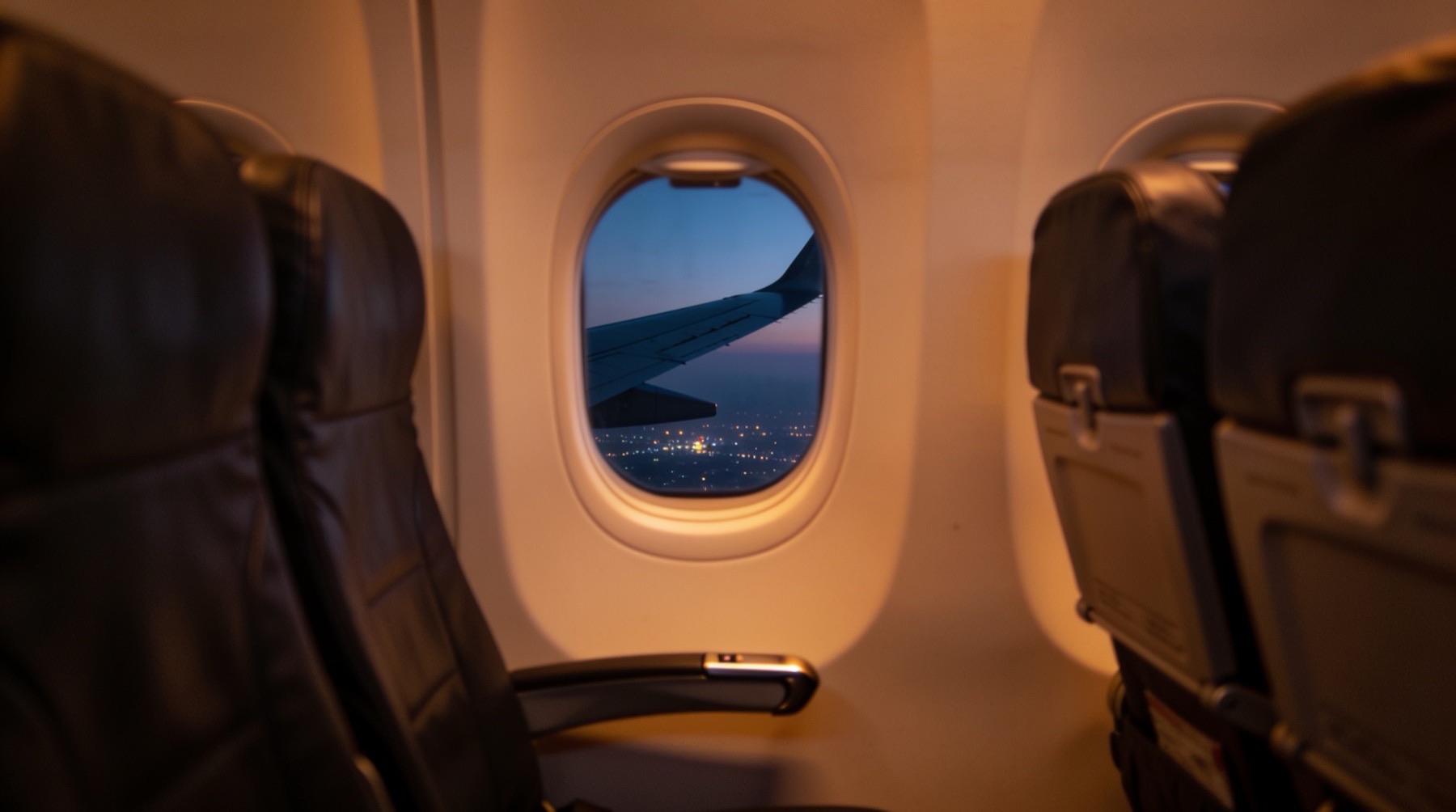
The deeper columns are patchy — the app only knows the seat for forty-odd sectors — but where there is data, there is testimony. Of the sectors with a recorded seat: window, 85 per cent. Favourite seat: 4A, twelve times. A window, well forward. On this the dataset does not equivocate; it is the most emphatic number in the file. Whoever this man is, he boards early, turns left out of habit and hope, sits down at the window just behind the flight deck, and watches.
And then there’s this. The most-flown aircraft in the log is not a type. It is a tail. VH-VXU, a Boeing 737-800 — Qantas names its aircraft, and this one is called Wollongong — carried me five separate times across the years, more than any other single airframe on Earth. I have a favourite individual aeroplane. I did not know this until Tuesday. Its name is Wollongong. It is named after a town I could drive to in ninety minutes, and I have crossed continents in it.
The zeros
But the real findings of any audit are the absences, and this one has two.
Perth. Here the log and I part company, because the log is emphatic — zero sectors, all-time, not one in 245 — and the log is wrong. I have been to Perth. Several times. But every one of those visits happened before 17 January 2010, which is the day the record begins, and so as far as the ledger is concerned they are apocrypha: undated, unrowed, prehistoric. Sixteen years of flying is only sixteen years of recorded flying; everything earlier happened off the books, in the era the dataset can only describe as before records began, like rainfall before anyone installed the gauge. Within the documented era the roll-call is absurd — Buffalo, yes; Glasgow, yes; Penang, Nadi, Las Vegas, all logged — while the largest city on the western half of my own continent sits at zero. So the spreadsheet is not saying I never went to Perth. It is saying something stranger and, once I saw it, sadder: that in the entire documented era, I never once went back. And here is the shameful part. My files contain a reference note for Perth Airport anyway — written with care, frontmatter and everything, labelled in my own hand aspirational — a word I apparently chose for an airport I have stood in. That is what sixteen undocumented years does to a place: it moves from memory to ambition without passing through the log at all.
The Boeing 717. The odd little T-tailed thing with the engines mounted on the back, which is not really a Boeing at all — it was born the McDonnell Douglas MD-95, and became a “Boeing 717” only because Boeing swallowed McDonnell Douglas while it was still on the drawing board, then recycled onto it a model number previously used for a military tanker. An aeroplane wearing a name with no lineage in it. I have never been aboard one. And it, too, has a note in my files: the rows forward of the wing are remarkably quiet, because the noise is all at the back; the wing is clean, no engine slung beneath it, so you can actually watch the flaps and spoilers do their work; the cabin is 2–3 across — an odd number, which means that unlike the symmetrical 737 there is a genuine best side of the aircraft. I know all of this the way a birdwatcher knows a bird he has never seen. And the window is closing: production ended in 2006, the airline is retiring them now, and the replacements are already arriving. It is a collector’s zero with a deadline attached.
The wrong week
Which brings us back to the eighty status credits.
The highest-earning domestic sector in the country, as it happens, is Sydney–Perth: the longest route on the map, flown on a widebody with a lie-flat seat. The arithmetic is not subtle. The efficient answer to my deadline is Perth, and the universe has clearly enjoyed constructing the one force in existence strong enough to send me back after all these years: a loyalty-programme deadline.
And yet the plan I wrote for myself says no. Under deadline pressure you fly the routes with no surprises left in them — Singapore, ten sectors, well-worn, a known quantity down to the gate numbers. My planning note contains the sentence, about Perth, “That is the wrong week to be learning an airport,” and I stand by every word of it — whatever I once knew of that terminal expired sometime in the prehistory, and a sixteen-year-old memory of an airport is worse than no memory at all. I would simply note what the sentence implies: that there is a right week to be learning an airport, and that by my own records I have now had roughly eight hundred and thirty of them, and used none.
The blanks
A flight log looks like a record of movement. Read whole, it is mostly a record of repetition: the same city ninety-eight times, the same seat twelve times, the same individual aeroplane five times, named after a town down the road. The exotic rows are noise. The signal is the spine — and the two blank cells, which I now understand are blank in entirely different ways. The 717 is a true zero: it never happened, and the clock is running. Perth is a false one: it happened, and the ledger simply wasn’t there to see it — which makes it less a blank than an erasure, a piece of my life the data quietly declines to believe in.
So: Singapore will get booked, and the queue-determining tier will be defended, and the spreadsheet will get its tidy new rows. But the log is owed something better than tidy. Somewhere before they tow the last 717 off to the desert, there is a row to write for the true zero: an ordinary flight to somewhere unremarkable, on a misnamed aeroplane with its engines in the wrong place — window seat, forward of the wing, on the side with two.
And if, one day after that, a row appears reading SYD–PER, know that it wasn’t the status credits that did it. It was the other thing — the itch of a city I know perfectly well I have walked in, sitting in my own records as a place I have never been. Some rows you fly to earn.
That one I owe as a correction.