She Saw Clutter. I Saw Infrastructure.
I come from a long line of printers. My grandfather set type; ink runs in the family the way land or seafaring runs in other families. So when, somewhere in my early teens, I became fascinated by photocopiers — not computers, not cars, photocopiers — nobody should have been surprised. Reproduction was the family business. I had simply transferred to the modern department.
The method was systematic, because the whole point was the system. I telephoned the sales office of every copier marque on the Sydney market — Canon, Xerox, Ricoh, Mita, Konica, Minolta, Sharp, the lot — and explained, with the gravity only a teenager can produce, that I needed their brochures for a school assignment. The sales departments, bless every one of them, obliged. At Canon there was a man named Ray Dixon who sent brochures and posters with such generosity that eventually his secretary intervened. I consider him a patron of the arts to this day.
The collection lived in a briefcase-style filing case: alphabetical by marque, then ascending by copies-per-minute, which I maintain is the only correct ordering. When Mita and Minolta both demanded space behind the M divider — intolerable congestion — I deployed the briefcase’s otherwise-useless “Mc” tab and gave one of them a divider of its own. I regard this as an elegant systems hack and will not be apologising.
I pored over model numbers, copying methods, feeder types. I had opinions about the Reversing Document Feeder that I hold, unmoved, thirty years later. I especially loved the finishers — the sorters and staplers and folders, the machines that turned a stack of paper into a finished thing. And at the front of the case, sheathed in thick protective plastic, lived the treasure: a red special-edition magazine, titled in one vast word — PHOTOCOPIERS — that reviewed and compared every machine on the market. The whole industry, between two covers, mine.
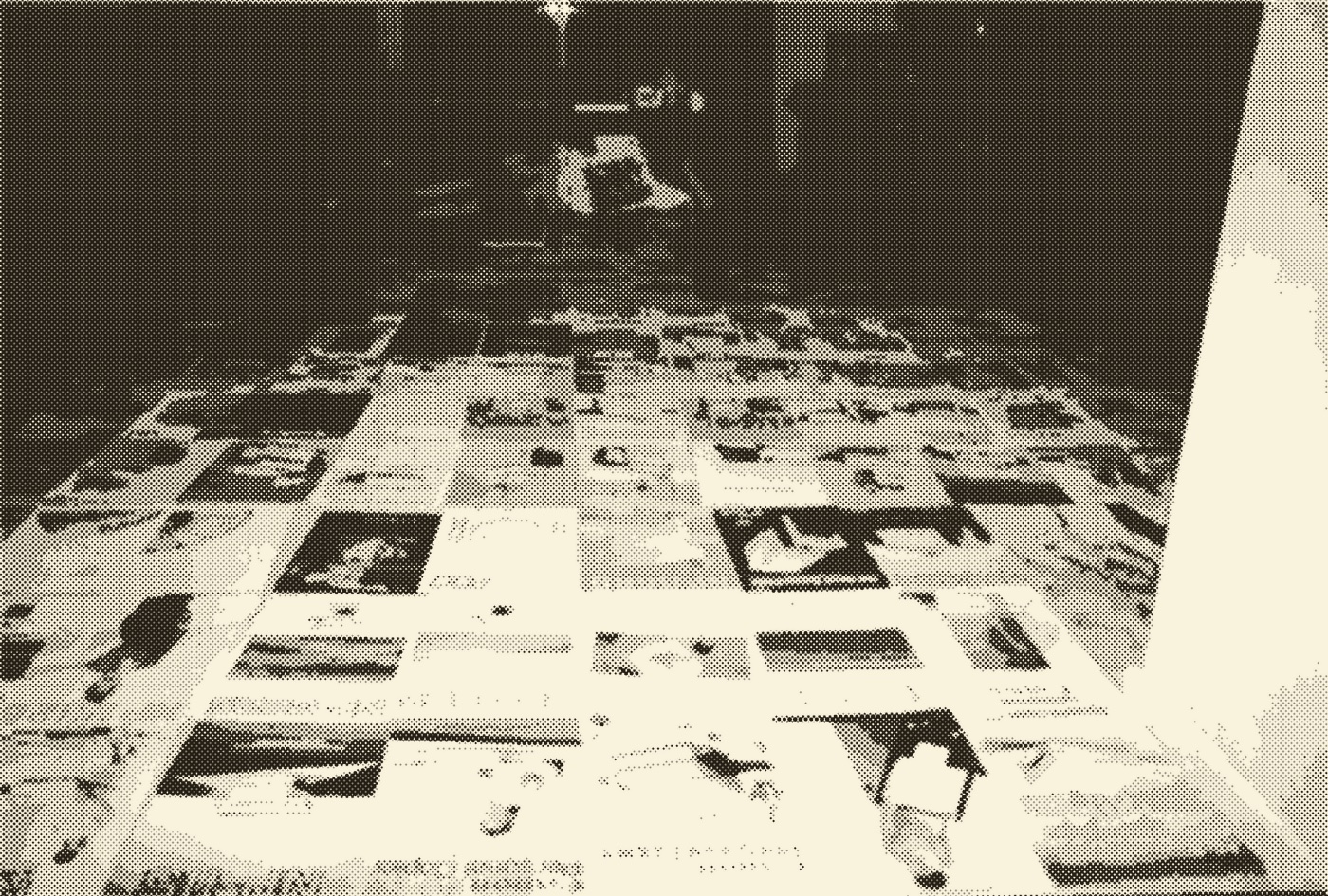
At its peak the collection required the lounge-room floor. All of it. Furniture was relocated. Hundreds of brochures went down edge to edge in a grid, and I lay behind them like a curator at a private view, which is exactly what it was, allowing for the attendance figures. There is a photograph. It’s the one at the top of this page, screened in halftone dots, because some images deserve to be printed the way their subjects were.
The Purge
You know how this ends. After my final exams, in the great clearing-out of my school life, my mother convinced me it was time for the collection to go. I obliged, in the way sons oblige. Briefcase, brochures, the red magazine in its plastic — all of it, gone in an afternoon.
She saw clutter. I saw infrastructure. The bin saw everything.
I have regretted it without interruption since, and I say that with love, because she was doing what mothers do. But I noticed something in the decades that followed: I became a person who documents obsessively, who builds verification systems, who never quite trusts that knowledge will survive without active preservation. Careers are just childhoods with budgets. I spent mine building operational systems — process, capability, reproduction at scale — and it took me an embarrassingly long time to notice I was rebuilding the briefcase.
The reprint run
This year, I actually rebuilt it.
Not the collection — nothing rebuilds the collection. The order. With considerable help from a tireless research department, I catalogued the photocopiers of 1990–2000 properly: four hundred and six machines across sixteen marques, every specification sourced or honestly marked unverified. The red magazine was identified after thirty years — it was a photocopier special of What to Buy for Business, Australian edition, and the masthead rang a bell the moment I saw it again. The magazine itself was re-typeset: seventy-two pages, red cover, light yellow stock, halftone plates, a comparison matrix filed ascending by speed, and a special feature on the finishers, which always deserved one.
Even the loose ends started surrendering. A childhood memory of a fugitive hiding inside a photocopier to escape capture — which I half-doubted for decades — turned out to be real: Switching Channels (1988), Henry Gibson folding himself into the press-room copier, in a remake of The Front Page where the roll-top desk of 1931 had been upgraded to the desk’s successor appliance. The machine I remembered him hiding in checks out too. Some archives are just waiting for you to come back and finish the verification pass.
The whole thing is now public: photocopier.gethryn.com — the machines, the magazine, and a standing invitation to anyone who sold, serviced, or hid inside one of these machines to help fill the gaps. Ninety-one machines are known only by name. If you ran one, I want to hear from you.
What this is actually about
It would be tidy to say this was about photocopiers. It was never entirely about photocopiers.
It was about the discovery, at age twelve, that the world can be catalogued — that if you file things properly, compare them honestly, and mark what you don’t know, chaos becomes navigable. Every prioritisation matrix I’ve built since, every comparison framework, every verification system, is the red magazine wearing a lanyard.
The collection is gone. The order came back. And the order, it turns out, was always the part worth keeping — the brochures were just where it lived.
Reproduce reliably.