Since the 1500s
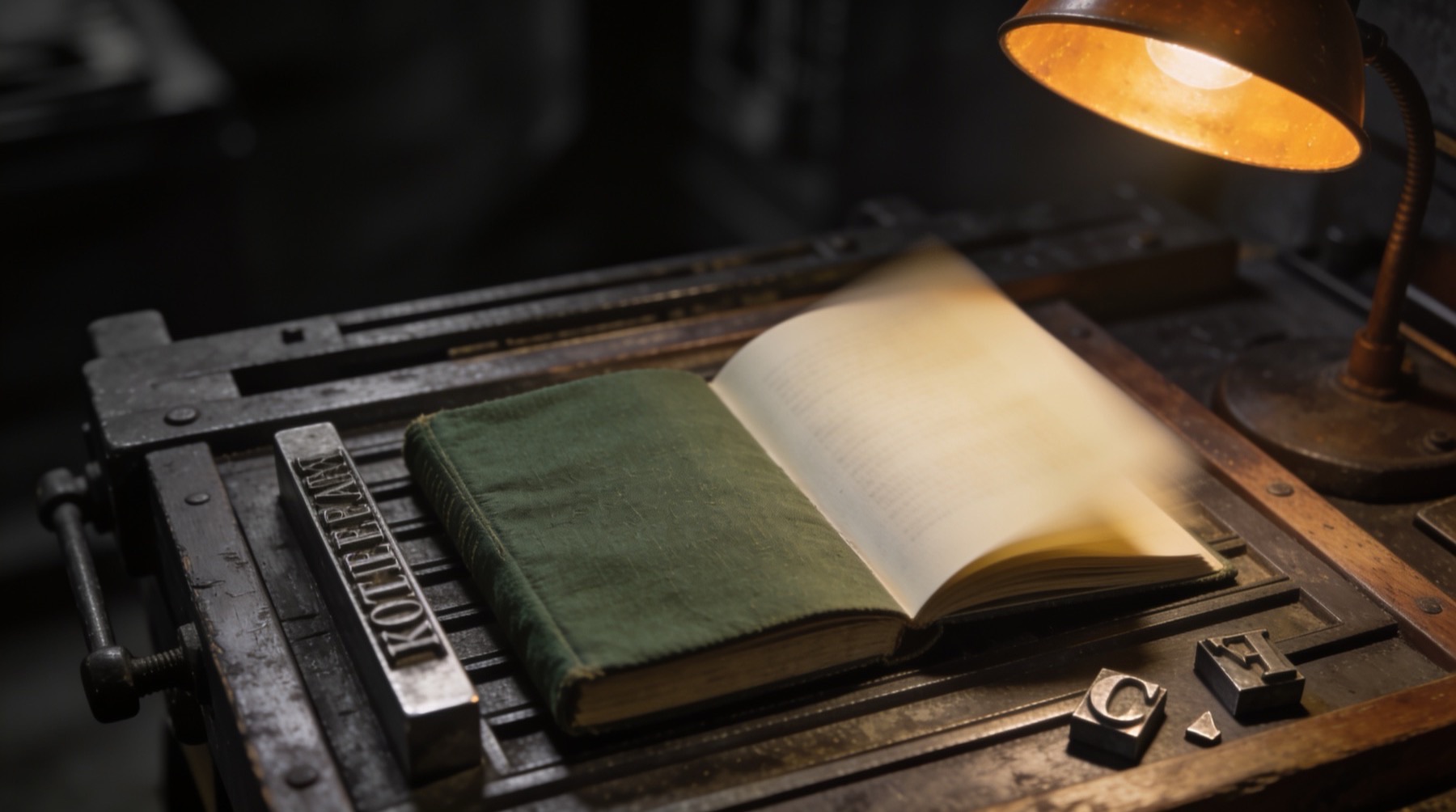
On lorem ipsum, the most-printed text nobody has ever read — and the pleasure of watching its fake provenance collapse and its real one turn out better.
You have seen one text more often than any other text in your life, and you have never once read it. It begins lorem ipsum dolor sit amet, and its entire job is to be looked at without being read: to occupy the place where words will go, so a designer can judge a layout before the copy exists. The trade calls the practice greeking, which is charming, because the text is Latin. Sort of. We’ll get to that.
What interests me about lorem ipsum is not the text. It’s the label on the text. Because nearly every generator, tutorial and design manual that ships it also ships its origin story, and the origin story is always, word for word, the same: lorem ipsum has been the industry’s standard dummy text ever since the 1500s, when an unknown printer took a galley of type and scrambled it to make a type specimen book.
Read that again with the eyes I acquired standing over a casserole dish on a Marrickville nature strip: that is a provenance. An anonymous craftsman, a specific century, a plausible act, no names, no sources, infinitely repeated. It is the “belonged to a sea captain” of the design world. And provenances, as we have established on this blog, deserve checking.
The professor and the missing half-word
The first person to check one end of it was a Latin scholar named Richard McClintock, in the 1980s, and his way in makes me unreasonably happy: he got suspicious about a single word. Consectetur is not the kind of word gibberish produces. So he went hunting, the way you can when Latin is your instrument, and he found the source: Cicero. De Finibus Bonorum et Malorum — “On the Ends of Good and Evil” — sections 1.10.32–33, written in 45 BC. A philosophical treatise weighing pleasure against pain.
And here is the detail I will be dining out on for years. The famous opening isn’t a sentence. It isn’t even a word. The original reads neque porro quisquam est qui dolorem ipsum quia dolor sit amet, consectetur, adipisci velit — “nor is there anyone who loves pain itself, who seeks it and wants to have it, simply because it is pain.” Somewhere between Cicero’s desk and your screen, dolorem was beheaded, and the world’s favourite filler text now opens mid-word: -lorem ipsum. Half a word about suffering.
Which means every brochure mock-up, every website template, every unfinished slide you have ever glanced past has been quietly asserting, in mangled Epicurean Latin, that nobody loves pain for its own sake. Sixty years of placeholder, and underneath it a real argument, decapitated but still faintly arguing.
Asking for the receipt
So Cicero anchors one end of the chain. But the other end — the unknown printer, the scrambled galley, the 1500s — sat unexamined for decades, printed and reprinted the way unexamined things are.
Then recently I watched someone do the obvious, monumental thing: ask for the receipt. A documentary investigation on YouTube — The Lorem Ipsum Mystery, by the channel Rabbit Hole — in which the creator goes looking for any actual evidence of the sixteenth-century printer. Old dictionaries. Typography manuals. Printers’ specimen books. Library archives. The kind of searching that involves physical objects and patient librarians rather than a search bar.
There is no printer. There is no scrambled galley. There is no 1500s. Nobody has ever produced a specimen of lorem ipsum older than living memory, and the famous backstory appears to be exactly what it reads as: a plausible anecdote that got typeset into fact by repetition. The provenance was forged — not maliciously, just decoratively, which is somehow perfect for a text whose whole purpose is decoration.
What actually happened
The real trail, the investigation found, leads not to a Renaissance print shop but to London in the mid-1960s, and to Letraset — the dry-transfer lettering sheets that were the instant type of their day: crisp fonts you rubbed down onto artwork with a burnisher, one letter at a time. Letraset needed a standard dummy text for its specimen material, something that looked like language without being readable enough to distract.
By an early Letraset designer’s account, the company consulted James Mosley of the St Bride Printing Library — the great archive of the printing trade — around 1966. The recommendation was Latin: familiar enough in shape to stand in for Western text, dead enough that nobody stops to read it. Cicero’s greatest hits were considered and rejected as too recognisable. What went out on the sheets, in late 1966 or early 1967, was the garbled De Finibus passage.
And then the fingerprint — the detail that elevates the whole investigation from research to detective story. The text on the Letraset sheets matches the page layout of one specific book: a 1914 edition of De Finibus. Line for line — including the break that cuts dolorem in half. The text doesn’t just descend from Cicero; it descends from one particular printing of Cicero, and the wound where lorem begins is the exact shape of that edition’s typesetting. Someone stood at a bench sixty years ago with that book open in front of them, keying in text from wherever the page happened to start. The mutilation isn’t mystery. It’s pagination.
I want to be clear about what that finding is. That is provenance work of the highest order — the same discipline that authenticates a painting by matching the weave of its canvas, applied to twelve words of broken Latin. The book is the paperwork. The page break is the signature.
The last carrier
One more link and the chain reaches you. In the 1980s, a designer named Laura Perry — who had spent years rubbing lorem ipsum down from those very Letraset sheets — became creative director at Aldus, the company building PageMaker, the software that invented desktop publishing. She carried the text with her, keying it into the product the way a tradition is carried: from memory and habit, complete with the occasional typo, which then shipped. The mutations propagated with the text, the way mutations do — which is why lorem ipsum today comes in slightly different strains, datable, like tree rings, to their point of divergence.
From there it was over. PageMaker put the text on every desk; the web inherited it from print; the generators inherited it from the web; and somewhere along the way somebody wrote ever since the 1500s underneath it, and that shipped too.
The better story
Here is the thing I keep turning over. The false provenance was boring: an anonymous printer, doing a vague thing, in a round-number century. The true provenance is magnificent: a philosophical treatise from 45 BC, beheaded by the pagination of a 1914 edition, chosen in a printing library in 1966 because the better-known option was too famous, rubbed onto a thousand paste-ups one letter at a time, carried into software by a designer’s muscle memory, typos and all, and finally — the crowning touch — fitted with a fake backstory more forgettable than the truth.
We do this, apparently. Handed an object with a genuinely strange history, we will invent a duller one, because a duller one asks nothing of us. The casserole dish gets a family it never had; the filler text gets a printer who never lived. The difference is that this time somebody checked — and the object under the foil turned out to be real.
Neque porro quisquam est qui dolorem ipsum… Nobody loves pain itself. But somebody, in 1966, loved twelve broken words of it enough to set them in every typeface they had. We still haven’t got their name. The provenance, as always, is one link short — and I find I don’t want the last link found. The seeking, as established, is the practice.