Swings, No Roundabouts
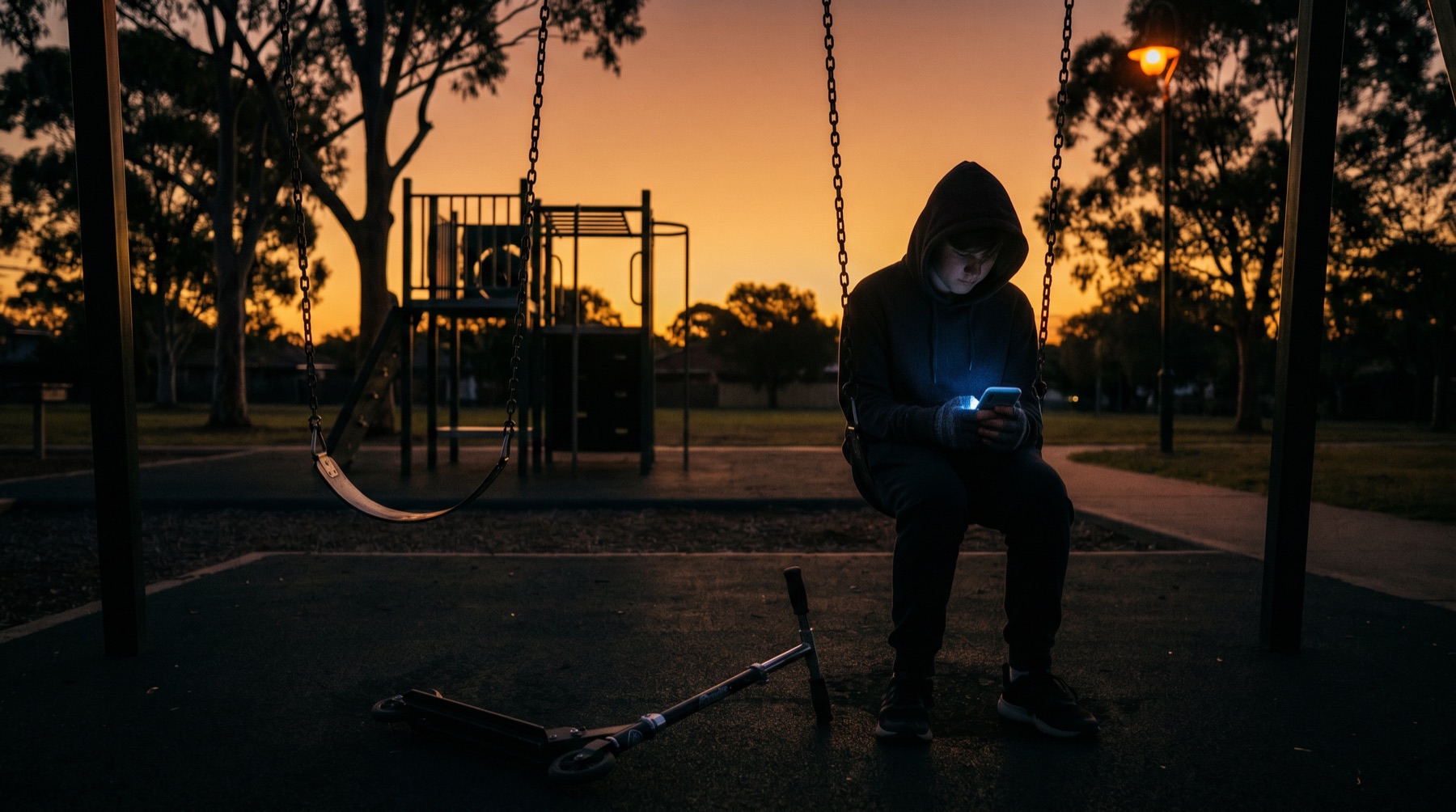
I watched a young man arrive at my local park today the way a comet arrives at a solar system: fast, silent, and slightly on fire with disaffection. He scootered in, dismounted without ceremony, and made straight for the swings. Not the good ones — the plain rubber sling on two chains, the kind that’s been the same since roughly the Bronze Age.
He sat. He pulled out his phone. And then he did something that I have not been able to stop thinking about since: he swung and doomscrolled at the same time.
Back and forth. Thumb flicking. Back and forth. Thumb flicking. Two rhythms, one boy — the ancient and the algorithmic, running in perfect parallel. He looked, for all the world, like a monk who had discovered that you can pray and check your notifications concurrently if you just find the right posture.
And I thought: what is it about swings?
The one thing that survived
Consider what has not survived. The see-saw is functionally extinct, culled by insurance actuaries who correctly identified it as a machine for teaching children about betrayal. The merry-go-round — the metal one, the centrifuge that flung you off into the tanbark — is gone, remembered only by adults who reflexively touch a scar when they talk about it. The monkey bars have been lawyered down to knee height. The tall slide is now a short slide with anger issues.
But the swing endures. Untouched. Unimproved. Un-disrupted. No startup has raised a Series A to reinvent the swing, because there is nothing to reinvent. It arrived complete. It is the shark of the playground — evolution looked at it early, said “yep, that’s the one,” and moved on to ruin other things.
What need is it actually tapping?
Here’s my theory, and I’ll thank you not to fact-check it.
A swing is the only socially acceptable way for a human being to experience falling on purpose, repeatedly, forever, with none of the consequences of actually falling. Your stomach does the little lurch. Your inner ear files a formal complaint. Some reptilian part of your brain that has been on high alert since we lived in trees briefly thinks this is it, this is how I die — and then the chain catches you, and you don’t, and you go up the other side, and you get to feel the relief of survival roughly every 1.5 seconds.
It is a near-death experience you can schedule. It is danger with the manager’s approval. We are, all of us, adrenaline junkies who have been talked down to the smallest possible dose.
That’s the appeal. It’s controlled falling. Which — and stay with me here — is exactly what doomscrolling is.
The two pendulums
Think about what the thumb is doing while the legs are pumping. The feed pulls you forward into something alarming — a war, a scandal, a man who has Thoughts about sourdough — and then flicks you away before it can actually land on you. Forward into dread, away before impact. Forward, away. Forward, away. A little lurch of the stomach, and then the relief of not this one, keep going.
The boy on the swing wasn’t doing two things. He was doing the same thing twice, in two centuries at once. His legs had found the analogue version of the exact loop his thumb was running. Falling toward something, being caught, flung up the far side, falling again. The oldest comfort we have and the newest compulsion we’ve invented turn out to be the same gesture — the body just got there about four thousand years early.
I don’t think he knew that. I think his body knew it, which is worse and also more beautiful.
The democracy of the thing
The other remarkable thing about swings is who uses them. A swing does not care. A toddler being launched by a beaming parent, a teenager pretending to be too cool while very much not getting off, a couple on a date who both “just want to have a quick go,” a man in his forties who tells himself he’s “testing it for the kids” and then stays for eleven minutes — the swing serves them all identically and judges none of them. It is the last genuinely classless object in public life. There is no premium swing. You cannot pay for a better arc. Gravity, mercifully, has not yet been monetised, though I assume there’s a pitch deck.
In defence of the disenfranchised
I’ve been calling him “disenfranchised,” which is unfair — I saw a boy on a scooter for eleven seconds and gave him an entire political condition. For all I know he’d just aced an exam and was rewarding himself with the finest pleasure our species has ever engineered: doing nothing, going nowhere, but moving.
Because that’s the secret the swing has kept the whole time. It is the purest expression of effort without ambition. You pump your legs, you work up a genuine sweat, and you arrive precisely where you started. No progress. No destination. No metrics. In a world that has turned everything — sleep, steps, mood, friendship — into a number that must go up, the swing quietly refuses to measure anything at all.
Maybe that’s the wavelength it found. Maybe that’s why it outlived the see-saw and will outlive the phone. It’s the one thing left that asks nothing of you and gives you the falling-and-being-caught for free.
The boy eventually stopped, pocketed the phone, remounted the comet, and left. The swing settled behind him, ticking back and forth, slower and slower, waiting with the infinite patience of a thing that knows it will be here long after the app is gone.
I nearly had a go myself. For the kids, obviously.