The Roast
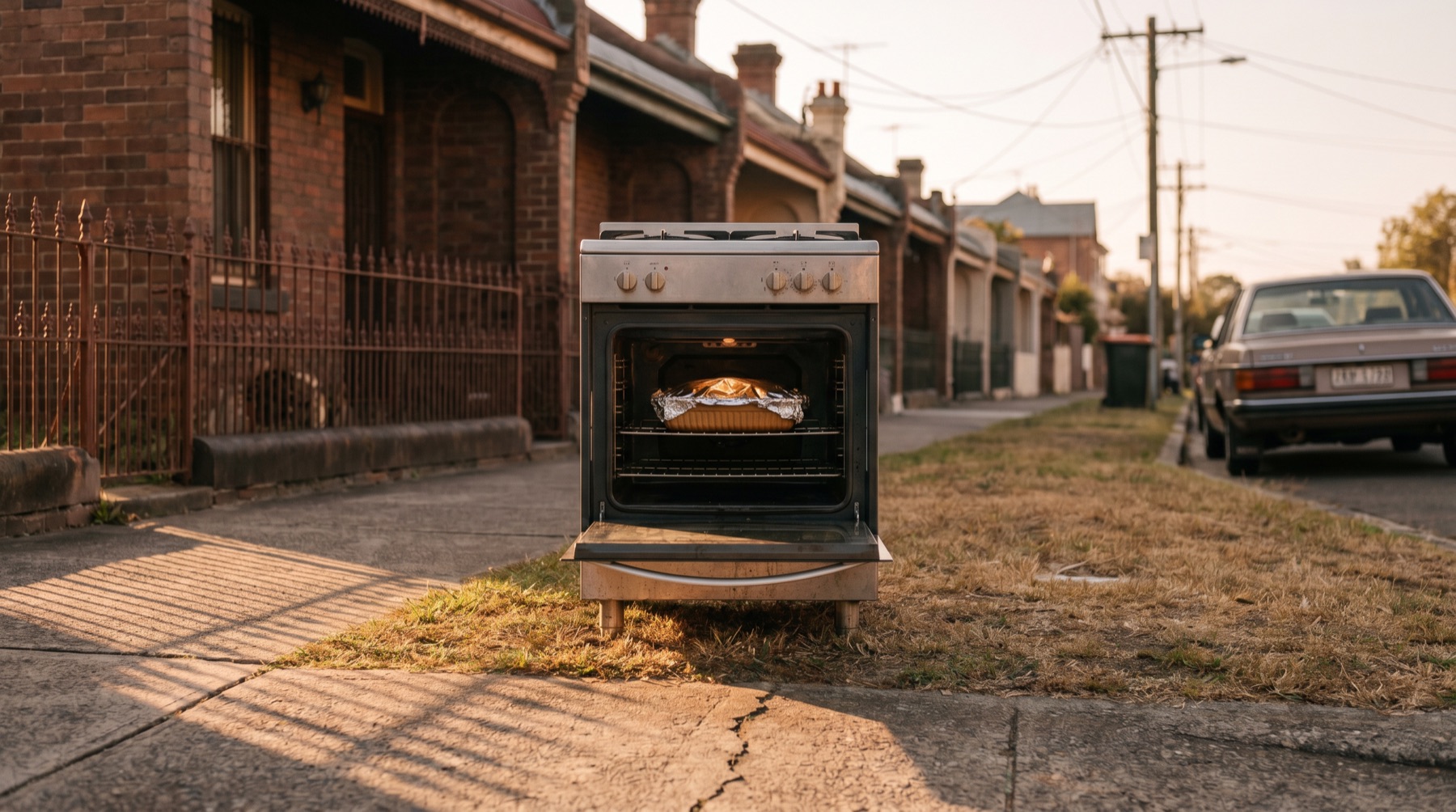
Marrickville, inner west, a Wednesday at about ten past ten: a full-size oven alone on the grass next to the pavement — nothing else out with it — one foil-covered casserole dish sitting on the rack.
I was walking. That’s all I was doing. A Wednesday, at about ten past ten — and I can be exact about that because I was late for something I can no longer identify — the street doing nothing, which is what it’s for, and about forty metres out I knew something was wrong.
I want to be careful here, because this is the bit I can’t explain. Nothing was unusual. An oven on the kerb isn’t unusual; Marrickville puts an oven out roughly the way other suburbs put out the recycling: regularly, with no particular feeling, and in the confident expectation that someone else will deal with it. I’ve walked past fridges and mattresses and a lounge that went out in three instalments over a fortnight, and once an entire kitchen laid out on the grass in the order you’d install it. An oven on its own is nothing.
And I want to be clear that this was an oven. Not a benchtop thing you could carry under one arm. A full-size Westinghouse, fan-forced, the kind that lives in the wall at chest height and comes out of its cabinetry only with two people, a screwdriver, and a grudge. Somebody had done that, and carried it out here, and set it down square on the grass, where it sat like a dog that has been told to wait outside a shop and has begun to suspect it won’t be collected. A lonely oven. I’d like that noted, and I’d like it noted that I noticed it before I noticed anything else.
And I slowed down anyway. Not decided to — slowed, the way you slow outside a house you used to live in, because something in the arrangement was off, like a room where a picture’s been moved, and I came to a stop in front of the lonely oven and directed a long, unreasonable stare at it, like a man who’d been asked to identify it.
And then I saw the dish.
It was on the rack, dead centre, and it was Aunt Betty’s casserole dish. Not my Aunt Betty — everyone’s.
There is a theory, which I hold, that Aunt Betty’s casserole dish is not a possession so much as a constant — like the speed of light, or the boiling point of water at sea level — a fixed quantity that appears in every kitchen in the country whether or not anyone in that kitchen has ever met an Aunt Betty. Nobody buys it. Nobody remembers receiving it. It is simply there, above the fridge, oval, with small flowers round the rim, having arrived at some point in the twentieth century by a process physics has not yet fully described, and it came out for the roast every Sunday for as long as there were Sundays, and then one day didn’t, and stayed above the fridge anyway, because it is not the sort of thing you can get rid of. It is only the sort of thing you can leave behind.
The one on the rack in front of me had been left behind. I knew it across a strip of grass. And it was covered, neatly, with foil pressed down over the rim and the edges tucked under, the way you cover a thing you mean to come back for.
Fresh foil, too. Not the dull, creased, three-days-in-the-fridge kind. Bright, unmarked, foil that had come off the roll that morning — foil that said, as plainly as foil can say anything, this just happened. And foil, for the record, is the only thing in a kitchen that cannot be applied by accident. Everything else — heat, salt, blame — arrives on its own. Foil has to be meant.
And here’s where it went wrong in my head. Because I could see a thousand ways a dish ends up in an oven on the grass, and even more ways an oven ends up on the grass with nothing in it at all; that’s just the ordinary traffic of the inner west, and I could have written you the paperwork, which is not, when you think about it, much of a thing to be able to say about yourself. What I could not see, standing there for a good deal longer than a man should stand in front of an appliance, was one story — one — that ended in this. A dead oven, a whole dish, fresh foil. All of it composed, and none of it explained.
The obvious thing was to lift the corner, and I didn’t, and I’d like that on the record along with the fact that it wasn’t bravado. I stood over it and I could not make myself do it, and after a moment I worked out why, and the reason was physics, which is not a kind of reason I normally have.
You’ll know the cat. There’s a cat in a box in a famous thought experiment, and until you open the box the cat is both alive and dead, and it’s the opening that decides; the looking collapses the whole thing into one answer. It’s a metaphor. Physicists will tell you it isn’t, and they’ve spent a great deal of money to be in a position to say so, but it is.
Under that foil there was either a roast or there wasn’t, and as long as I didn’t look there were a thousand roasts and a thousand reasons and every story on that street was still in play. Looking would have made one of them true — just one — and everything else would have died on the spot, and I wasn’t prepared to do that to a cat I’d only just met. It wasn’t my cat. I had no idea whose cat it was. That’s rather the point of the cat.
Schrödinger’s casserole. How very Marrickville.
Still. What. Had. Happened. Here.
My mind started offering hypotheses, the way a mind does, which is uninvited and at volume — and this is a mind that is not at its best before eleven and was being asked to do this at ten past — but I wanted a second opinion first, so I did what a man in my line of work does: I photographed it, and I sent the photograph to an AI with a one-word prompt. Discuss.
And it discussed — it’s good at that; it has, I sometimes think, no other setting — and it gave me a numbered list, which is what it gives everyone, in the way a certain kind of restaurant gives everyone bread: unasked, promptly, and as a substitute for the thing you came for. A deceased estate. A move-out. A neighbour returning a borrowed dish. A council collection in progress, a phrase which suggests the machine has read about councils but never waited for one. A “community food-sharing gesture”, which is not a thing that has ever happened on my street. And sixth, offered with the calm of a machine that has never been to Marrickville: someone may simply have forgotten.
Every one of them was possible, and not one of them had foiled the dish. It had explained the oven six times over and the foil not once, which is exactly the mistake I’d been about to make myself, only it made it faster and with better formatting. None of it was satisfying. So I did it properly, standing there, by hand.
I began, as one does, with the dead. The deceased estate: a kitchen cleared in a single hard weekend by relatives in a hired van — the sort of relatives who box a house the way you’d box a fight, quickly, with feeling, and without looking too closely at anything — and who never once opened the oven, because nobody opens the oven. The oven is where you don’t look. It is what the oven is for. A sound theory, and I was rather attached to it for about four seconds, until it occurred to me that somebody had foiled the dish, and you don’t foil what you never saw. The dead, I’m afraid, had an alibi.
The end-of-lease exodus, then. Out by ten, bond on the line, the last meal abandoned mid-plan by a man with a hire car and a resentful lamp. I liked him too. But a man fleeing a lease leaves the dish in the sink, with everything else he fully intends the bond to pay for, and nobody’s final inspection — nobody’s — ends with a casserole, centred, on the rack. I let him go.
The borrowed dish, returned at last by a neighbour with a point to make — and I know the neighbour, or one very like her, a woman who can set a casserole dish down in a way that constitutes correspondence. Except that you return a dish to a front door, not to a dead appliance on the kerb, even here, where a point is generally made with a laminated sign and a slightly too-long stare. Struck off, with regret. I’d have enjoyed her.
The fight. The meal that went out the front door still warm, oven and all, because somebody needed the entire apparatus of dinner out of their sight — and the inner west has seen it; the inner west has, in some cases, held the door and offered to take the heavy end. But even mid-fight, at the very summit of a domestic disagreement, with the neighbours’ lights coming on one by one down the street like a very slow round of applause — nobody foils.
And then the one I wanted. The one the machine hadn’t offered, because this one was mine. The one I very nearly kept.
He cooks Thursdays. That’s the arrangement, unspoken and load-bearing: she has the job with the lanyard and the lounge access and the Tuesday-to-Thursday somewhere else, and he has the house, and the casserole going into the oven at half past five on a Thursday is the flag run up the pole — a signal that a home is still operating here, that however the airline spends her week, the week ends at this bench, under this foil. Then one week the flights stop coming back. No scene, no slammed door; just a message about another few days that becomes another few, and the dish sitting foiled in the oven, waiting to be reheated, turning from tonight’s dinner into a question and then into an accusation. And there comes a morning when he can’t look at the oven with the dish in it, and can’t take the dish out of it either, and the difference between the meal and the appliance stops mattering — and the whole apparatus of Thursday goes out to the kerb as one object. One household. One catastrophe. Put out as a unit.
I stood over that oven and very nearly kept him, because he explains almost everything — the singleness of the object, the meal nobody could face — everything except the foil.
Because the foil was fresh. It sat crisp and unhandled, pressed down in one clean sheet, and the dish sat centred on the rack — centred, square to the front, composed — while the oven around it wore the scuffs of its argument with a doorframe. Grief doesn’t centre things. Grief can’t find the good scissors. A man carrying the worst Thursday of his life to the kerb dumps the whole business and doesn’t look back; he does not place the dish, straighten it, and step away to check the effect, in the manner of a man hanging a picture for a wife who is due home at six. That isn’t a man having the worst Thursday of his life. That’s a man with a gallery opening.
Every story I had was an accident story — the machine’s six, my five — and nothing about this was an accident.
Here’s a thing the inner west does. You don’t dump; you offer. You book the council for the genuine rubbish, and for anything with a flicker of life left in it you write a sign — Free to a good home — and tape it to the thing so passers-by know it’s a gift and not a defeat. The signs have a house style, apologetic and arch, like the suburb, which apologises for everything it does and then does it anyway. I once passed a white bookshelf wearing a note that read Free to a good, bad, or indifferent home, and it was gone by lunch, so somebody indifferent got there first. Ninety per cent of the time they work: the object is liberated, wheeled off to be sanded back and upcycled into a planter, a bar, a better version of itself, which is more than most of us get.
This oven had no sign. What it had was a dish, which is a far more ambitious caption, and which is where, if you follow me, the affair of the oven stopped being about the oven.
I should explain that the brain, in my experience, does not do its best work when asked. It does it three days later, at a bus stop, when you have given up and bought bread.
Which is where I was — stop 220420, Marrickville Road before Illawarra Road, a thoughtful bag of bread, a 426 due in four minutes according to a sign that has never once been right — when I looked down at the bag, for no reason, the way you do, and it did the thing.
The bread had come in a bag. Carried. On foot, from somewhere else entirely, and put down. And so had the dish.
Not the oven. The dish. It hadn’t been forgotten in that oven, or fled from, or thrown out with it. It had arrived — in a bag, on foot, from a kitchen the oven had never seen — and been set down on the rack by somebody who then walked away with the bag. The two of them had never met before that morning. Somebody had introduced them.
And I knew. Not guessed, not shortlisted, not — and I want to be clear about this, because the distinction has been costing me sleep — hypothesised. Knew, the way you know a tune from two notes. The whole thing arrived at once and in order with the ending attached, the way a good idea does and a bad one never quite manages, and I stood on the pavement with my mouth slightly open and a bag of bread I had apparently just deduced, and let a bus go without me, which the driver noted, and which I shall be hearing about, in the way one does, for some time.
It was so Marrickville I very nearly said it out loud to a woman with a pram, who had done nothing to deserve it. And it was right. You’ll have to take my word for that. I have no evidence for any of it, and I would like that on the record — I would like a great deal on the record by now, and I’m aware the record has started to look at me — before I say another word.
She waits for the right oven the way other people wait for a season.
The inner west is always shedding things — a fridge here, a mattress there, a lounge gone grey in the rain — no schedule to it, no roster, just the steady tidal deposit of a suburb forever replacing itself. She reads the streets for it the way she once read a catalogue. She doesn’t drive. She walks, with a tote bag, and in the tote bag she carries a dish and a roll of foil, and she waits until she finds the right appliance: already dead, already discarded, put out by someone else for reasons of their own. She likes them alone. Company on the kerb dilutes it; a single object, out on its own with nothing to explain it, already reads as intent. A lonely oven is halfway to a story before she’s opened her bag.
She never places the appliance. This is the one rule of the practice, and she is strict about it, the way you’re strict about the things keeping you upright. She only ever completes what is already there. The oven has to be innocent — genuinely, boringly discarded, no story of its own — because the whole point is what she adds. Anyone can plant both halves; that’s just lying. To plant only the dish is something better. She has thought about this a great deal. She has the time.
For thirty years she authenticated other people’s histories — a provenance researcher, back rooms and salerooms, the paper spine of things. Give her a chair, a canvas, a christening gown, and she could build the chain of it: this owner, that dealer, this gap where the war went through, until the object stood up and became worth something. She was very good. She understood early the thing the trade pretends not to know — that the object barely matters. The story is the asset. A plain deal table with the right three names behind it will outsell a finer table with none. People don’t buy the thing. They buy the thing’s past.
Then the past caught up with her own object, the one in the tote bag. Her mother’s dish. The one with the small flowers round the rim, the one that came out every Sunday for a roast for as long as there was a Sunday and a mother to make one. When the house was cleared she kept exactly one thing. This.
And she found she couldn’t do any ordinary thing with it. Couldn’t display it, couldn’t cook in it, couldn’t give it away, couldn’t throw it out. It had too much provenance — so heavy with history it had become unliftable, a document she couldn’t file. So she made it light again the only way she knew. She started lending it a false one.
She foils it fresh each time: a clean sheet, pressed down over the rim, because the foil is the seal and the seal has to look unbroken. She sets it on the rack of whatever dead oven the week has provided. She steps back and reads it as a stranger would, and when it holds — when the empty dish under the bright new foil throws off exactly the story she wants, a family, a meal, a leaving — she lifts it back off the rack, folds the foil into her bag, and walks home. The oven keeps the memory of it for a day, until the truck comes. The dish goes back with her. It has done this a hundred times. It is, she thinks, the only provenance the dish has left that she can bear: the false one, written fresh each week and taken home before it can set.
This morning she didn’t pick the dish back up.
She isn’t sure, even now, why. The oven was good — a full-size Westinghouse, fan-forced, honest, thoroughly dead, put out by someone on Illawarra Road who will never know what it briefly became. The light was right. She foiled the dish, set it, stepped back, and the story came off it clean — the cleanest it ever had. And then she looked at it on the rack, her mother’s flowers hidden under a seal she’d pressed that morning, and understood that she had finally made the object light enough to put down.
So she left it. Foil on.
She walked out from under thirty years of other people’s histories and the one of her own, back along Illawarra Road in the sun, and somewhere around the third block she noticed she felt inexplicably lighter and couldn’t, for a moment, think why.
A man came past it later with his phone. She didn’t see him. He slowed forty metres out, for reasons he couldn’t have given you, and photographed it the way you photograph a thing you can’t explain, and stood there a while building a whole family out of a dish that never held anything but a roast for a woman who was gone — and then he walked on, and the object had its provenance at last. One witness. One image. No name.
Nobody called the council. On the second day a young couple stopped — the kind who look at a dead oven and see it sanded back, re-enamelled, a planter for the courtyard — and they took it, because the inner west takes everything eventually. They took the dish too. It was sitting right there, flowers and all, and it seemed a waste to leave good ceramic out in the weather. It’s in a stranger’s kitchen now, her mother’s dish, holding lemons or car keys or nothing at all, accruing a history no one will ever be able to trace and that has, at last, nothing to do with her. Which was more than she’d hoped for. She had only meant to put it down. She hadn’t let herself imagine someone might pick it back up.
She kept the tote bag. She hasn’t used it since. But she keeps it by the door, the way you keep a thing that actually worked.
By the weekend it was gone. Where, I couldn’t tell you: the council, or a young couple with a courtyard. I didn’t see either, which means — and you’ll be ahead of me here — it’s both. That’s a second cat, if you’re counting, and I’ve been careful with this one too. I have not rung the council. Somewhere there’s a truck with an oven in it and somewhere there’s a courtyard with a planter, and as long as I don’t check, they’re both true. The couple are mine, I should say; I needed somebody to pick it up, so somebody did. And the dish is in a stranger’s kitchen holding lemons, or it’s in a tip, or it’s still on the rack in a shed I’ll never see. Three dishes. I’m keeping all of them.
There’s a word for all this. It was on the tip of my tongue for three days, in the way words are when you most need them, and it turned up at the stop with the bread, unasked, the way they do, and it has been following me around ever since like a dog that’s decided we’re friends. Provenance. In the art world it’s the whole game: an object’s worth is its documented past, who owned it and where it hung and who vouched for it, so a canvas with paperwork is a masterpiece and the same canvas with a gap in its story is a problem — and a problem, in the art world, is a masterpiece with a lawyer. Somebody clever said something about this once — I want to say Wilde; it’s generally Wilde when I can’t remember — but the gist was that provenance is what turns an object into a work, in roughly the way a knighthood turns a person into a Sir: nothing about the object has changed, and everything about how you’re allowed to stand near it has.
And what I’d walked into on a Wednesday was provenance in reverse: a thing with no history worth having, a council clean-up oven indistinguishable from ten thousand others, granted one. Not a true history — a fabricated, irresistible one, primed to go off in the mind of whoever walked past. The dish was a forged document and the foil was the wax seal, and that, I think, was the wrongness at forty metres, before I could see a dish or foil or anything: two things that had never met, standing together as if they’d always been there. The mind clocks a forgery before it can read the signature.
I read the whole thing off the rack in about four seconds and then spent ten minutes on the pavement, and a machine’s worth of electricity, auditioning candidates for it, exactly as I was meant to — authenticating a story that had been planted for me to find. I was, in the strict sense, the mark. I’d like that noted.
And I never lifted the corner. The cat stayed in the box. Lifting the foil is checking the paperwork, and some provenances are worth more left unexamined — the not-knowing is the value. Under there was either something, a real roast, a real past, the maker’s own history folded in; or nothing, an empty dish, the purest possible forgery, a provenance with no object at all. I couldn’t tell you which is more moving, and I’ve decided not to find out, which is the most disciplined thing I’ve done this year and consisted entirely of not doing something, which is my preferred discipline.
And standing over the bare patch of grass it left, I realised I was the only record. One photograph on a phone on a Wednesday, one word typed under it to a machine that did its best, and a story I made up at a bus stop, holding a thoughtful bag of bread. Whatever that object was, whatever history it had or only pretended to, I’m its provenance now — the first and last entry in its catalogue — which is precisely the trap that was set, and I walked into it holding my phone like a man signing the guest book at a wake for someone he never met. And then staying for the sandwiches.
A sign gives an object a future. The dish gave it a past.
I’m keeping the photograph.
The oven was real. The dish was real. The foil was real. The cat is still in the box. If you find something on the kerb you can’t explain — don’t lift the corner.