The Seer of Hornsby
Some people are places. This is about one of them, and about going back for something thirty years too late.
Every railway station has its fixtures. The indicator board. The bench nobody sits on because of the pigeons. The kiosk that has been “under new management” since before you were born. And at Hornsby station, in the first half of the 1990s, when I passed through daily in a school uniform, one of the fixtures was a man.
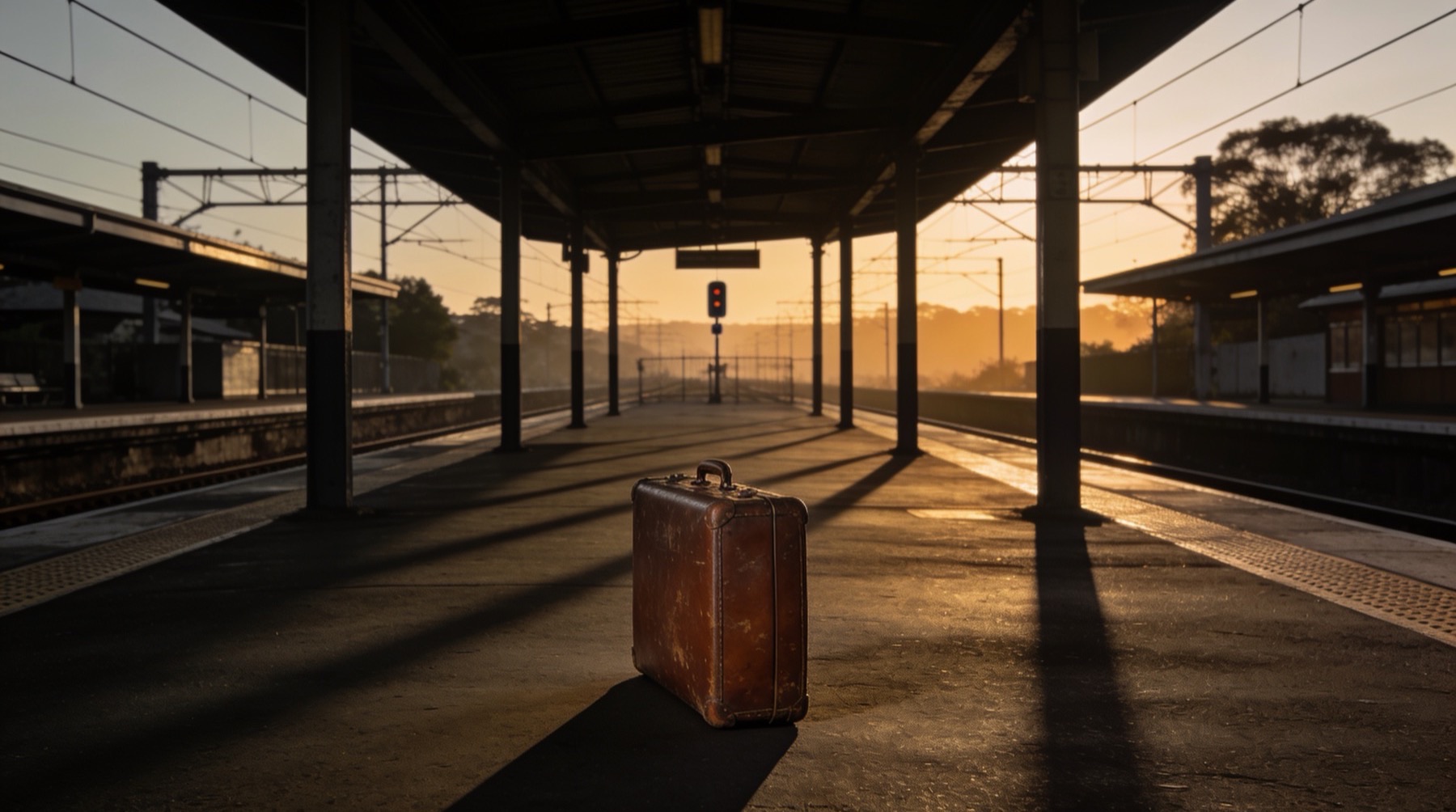
He was oldish — though I was fifteen, and fifteen files everyone over forty under oldish — and he travelled with a giant suitcase, and out of the suitcase he sold leather bracelets. Plaited ones, made by hand, by him, as far as anyone knew. He didn’t hawk. He didn’t call out. He was simply there, on the platform or near it, year after year, the way the overhead wires were there. Part of the station’s permanent equipment.
I never bought one. Five years of high school, thousands of passings, and I never once bought the bracelet. I had my reasons, in the way a fifteen-year-old has reasons: no money, no need, a train to catch. And underneath them, the real reason, which is that the bracelet was always going to be there tomorrow.
That’s what fixtures are for.
The reappearance
Then school ended, and I left, and the decades did what decades do.
And in 2021 — call it twenty-five years later — I saw him again.
I want to be careful here, because my memory of this is doing two contradictory things at once, and I’ve decided to respect both. I am certain it was him. Definitely him is what I wrote down at the time, and I stand by the certainty even though I can no longer tell you where it happened — Newtown, maybe, or Hornsby again; the location is a fog. That’s the strange arithmetic of the thing: the identification is granite and the geography is mist. Memory filed the who and shredded the where, as if only one of them mattered.
And here is the part that made it unfilable. He had not aged.
Twenty-five years. The same man, the same suitcase, the same trade. A quarter of a century is supposed to do something to a person — it had certainly done things to me. On him it appeared to have done nothing at all. I stood there holding a memory from a school platform against a man on a footpath, and the two matched better than photographs of me taken the same distance apart.
I’ll note one more thing and draw no conclusions from it. In 2021 I was beginning — in the most embryonic, not-yet-admitted-to-myself way — to think about leaving a job I had been in a very long time. When a figure from your departures platform reappears, unaged, at the exact moment you are quietly contemplating a departure, some part of the mind sits up very straight. You can tell that part of the mind it’s being dramatic. It doesn’t listen.
The pilgrimage
This year I decided to close the oldest open item on the ledger. I would go back to Hornsby — deliberately, on a weekday I keep for myself — and I would find him, and I would buy the bracelet. Thirty years late. A mark of passage, finally paid for.
I made a proper outing of it: the better part of an hour up the line, a station I once knew the way you know a childhood house, every stair and sightline still in the right place and all of it smaller than the version I keep indoors. I walked the concourse. I walked the platforms. I gave it time, the way you give a fishing spot time.
He was not there.
I’d like to report that I took this philosophically from the first moment, but the truth is there was a solid minute of standing on the concourse feeling like a man who has arrived at a shop thirty years after closing time, which is approximately what I was. And then something unexpected settled over the whole expedition, and what I wrote that evening was this: It’s fine if he’s not there. I can try again.
Which surprised me more than the empty platform did. I had gone up the line for a transaction. Somewhere around the turn for home I understood that the looking was the thing I’d actually bought.
The corroboration
Because here is what I did next: what everyone does now with a mystery. I went looking online.
And I found a thread — the Sydney subreddit — asking whether anyone remembered the old man who used to sell leather bracelets around Town Hall in the eighties and nineties.
Dozens of people remembered.
Town Hall. Central. Pitt Street Mall. Martin Place. The suitcase, described by strangers exactly as I would have described it. The coat — a detail I hadn’t kept, but the thread was emphatic — a trench coat, worn in all weathers, including the ones that don’t call for a trench coat. Nobody knew his name. Nobody agreed on where he was from. The accounts ran from the 1980s to a confirmed sighting in mid-2022: Pitt Street Mall, still with the coat. More than one commenter still owned a bracelet — thirty years old and holding. And more than one of them said, unprompted, the exact impossible thing I had been carrying privately since 2021: he doesn’t seem to age.
“Sydney feels like an open-world game with all this lore and side characters,” one of them wrote. I have not stopped thinking about that sentence since.
The catalogue
Consider what that thread actually is.
It is a provenance — a crowd-sourced catalogue of appearances for a man about whom nothing else is recorded. No name, no history, no explanation. Just sightings, spread across five decades and half the stations of Sydney, contributed by strangers who never met each other and all describe the same coat. In the art world a provenance is the chain of custody that makes an object real: who saw it, where it hung, who vouches. By that standard he is one of the best-documented people in the city. Hundreds of his bracelets are out there on ageing wrists, and every one of them is a certificate: he was on that platform, that decade. I was there. It happened.
And notice — the thread noticed, I noticed, you’ll notice — where all those sightings are. Stations. Concourses. The mall that funnels one station toward another. Never a destination; always the places people pass through on the way to somewhere else. Whatever he is selling, he has spent fifty years selling it exclusively at thresholds. In older stories than mine there is always a figure who waits at the crossing-place, and the travellers who stop and pay the small toll are the ones whose journeys go well. I am not claiming he is anything of the sort. I am telling you that once you have missed him at a station you passed through ten thousand times as a boy, it is not possible to avoid the thought.
The open item
Mid-2022 is a while ago now, and I’m aware of what the arithmetic of oldish in 1991 implies. The window, as with most things I catalogue, is presumably closing.
So I’ll keep trying. Hornsby some weeks, Pitt Street Mall others — not urgently, and, this is the part I didn’t expect, not really wanting to be finished. The ledger has carried this item for thirty years; it can carry it a little further. A bracelet bought at fifteen would have been a trinket. A bracelet bought now would be a document. The price has never been better.
And if you’re in Sydney, and you pass through a station, and you see him — tall, thin, the coat regardless of season, the suitcase — buy the bracelet. Buy it that day. Don’t do what I did. Don’t assume the fixture will be there tomorrow.
That was never what fixtures are for. It’s just what they let you believe.