Day 270 of No Year in Particular
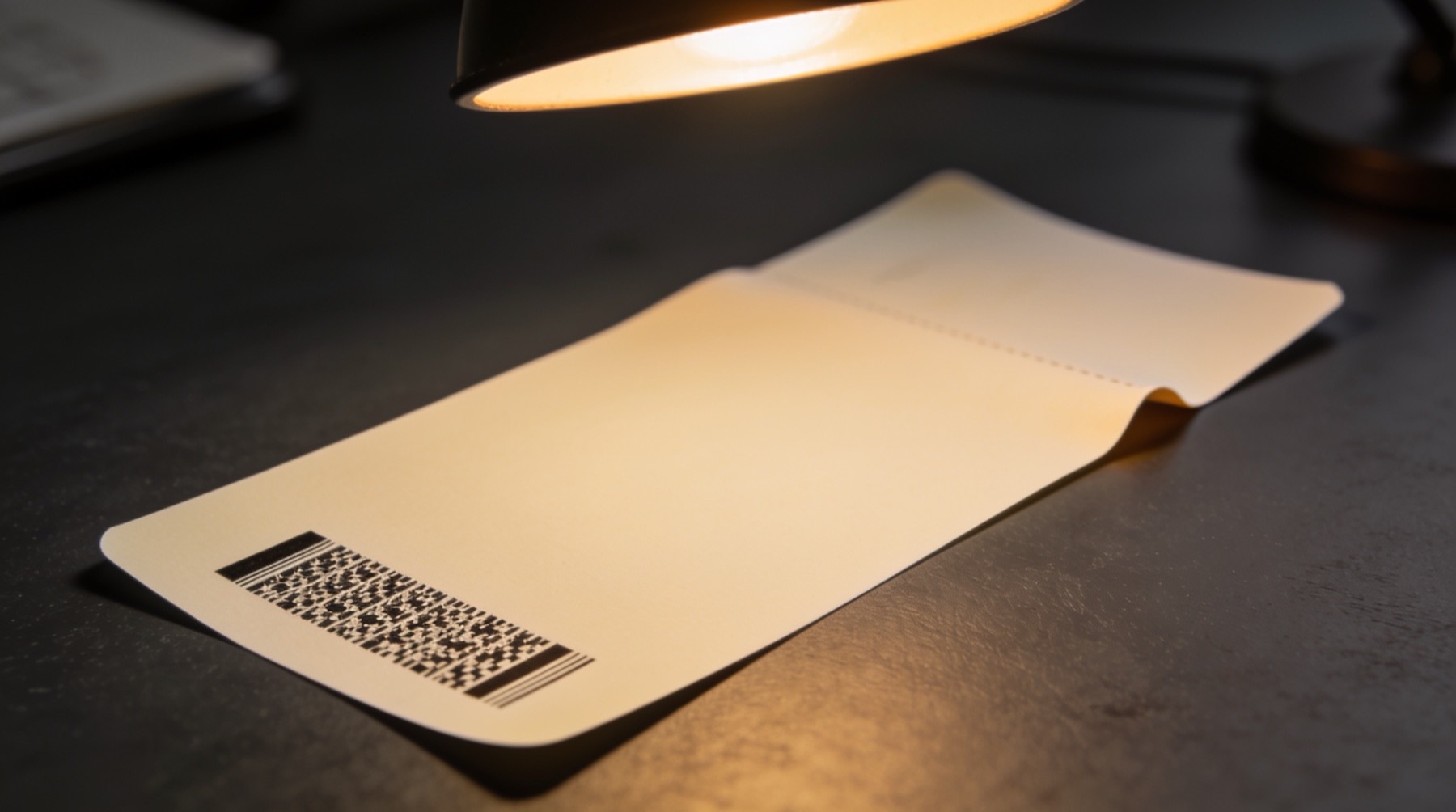
On the barcode of a boarding pass, which knows your frequent flyer number, your check-in habits, and precisely when it was printed — but not, strictly speaking, what year you’re flying.
Everyone has held a boarding pass. Almost nobody has read one — because the interesting text on a boarding pass isn’t the text. It’s the barcode: the squat, striped block you’ve spent your whole travelling life not looking at, which carries considerably more information than the printed face above it, and carries it in a format so plain, so trusting, and so magnificently 1980s that reading the standard cover to cover — which I have done, and I want you to know that I understand what that says about me — feels less like reading a technical document and more like archaeology.
The standard is called BCBP — Bar Coded Boarding Pass — and it lives in a document called IATA Resolution 792, and the striped block itself is a symbology called PDF417, or a QR code if your pass lives on your phone. But what’s inside is the good part. Inside is a single line of fixed-width ASCII text. No encryption. No labels. No delimiters. Every field is defined purely by its position: field four is field four because it starts at character twenty-three, not because anything in the string says so. The entire global machinery of boarding — every gate, every scanner, every airline, every airport on Earth — is held together by the simple collective agreement to count characters carefully.
I find this beautiful and mildly terrifying, which is my favourite combination.
Twenty characters of you
The first thing the barcode stores about you is your name, and it allots you exactly twenty characters to have one in: SURNAME/FIRSTNAME TITLE, space-padded, and truncated — without apology or appeal — at twenty.
This single design decision, made decades ago by someone squeezing a human identity into a barcode, is why long names come out mangled on boarding passes to this day. Somewhere in the eighties, the format quietly decided how long a person is allowed to be, and the world’s Papadopouloses and Wolfeschlegelsteinhausens have been paying for it at check-in counters ever since.
GHAVALAS/GETHRYN MR is nineteen characters. I fit, with one to spare. I have never felt so efficiently designed.
The day without a year
Then there is the date field, which is my favourite broken thing in all of aviation.
The date of your flight is stored as a three-digit Julian day: the day of the year, 001 through 366. Day 270 is late September. And that is all the barcode says. Not which September. Not which year. The format, built in an era when every character was precious, decided that the year was somebody else’s problem — the pass would be scanned today or tomorrow, so why spend digits on the obvious?
Which means every boarding pass ever printed is, read literally, a standing appointment. Day 270 comes around every year, forever. The pass doesn’t expire so much as recur — a little paper Groundhog Day, eternally valid for the 270th day of no year in particular.
And here is the detail that elevates the whole thing from quirk to poetry: buried in the optional data at the end of the string, the pass’s date of issue does carry a year digit. One. Just enough to know when it was printed. So a boarding pass knows its own birthday more precisely than your departure. It is a document more certain of when it came into existence than of when you’re leaving — and honestly, same.
A journey in one character
My other favourite field is a single character called passenger status, which compresses the entire emotional arc of air travel into one digit:
0 — ticket issued, not checked in. 1 — checked in. 2 and 3 — the bag has gone, with or without you having formally followed it. 4 — through security. 5 — passed the gate. Boarded.
That’s it. That’s the journey. Every anxiety of the airport — the queue, the laptop out of the bag, the belt, the gate change, the final call — reduced to an odometer ticking from nought to five. By the arithmetic of my own flight log, some scanner somewhere has recorded me becoming a 5 roughly two hundred and forty-five documented times. There are worse biographies.
And the standard, being a real standard, is sedimentary — it keeps its fossils. Deep in the companion codes that ride along with bookings there still exists NSST: no-smoking seat. A code for requesting the non-smoking section, alive and formally defined in systems serving aircraft where nobody has been allowed to smoke this century. Nobody has deleted it. Deleting things is how you break formats that run the world; the industry knows this, so the no-smoking seat survives in the machinery the way an appendix survives in the body — useless, harmless, and proof of what the organism used to eat.
The whole sentence
Enough vocabulary. Let’s read one.
Here is the complete string inside the barcode of an entirely invented flight — decode it all you like, the booking does not exist, and day 270 of no year in particular is a difficult flight to turn up for anyway:
M1GHAVALAS/GETHRYN MR EABC123 SYDSINQF 0001 270Y028A00420300Sixty characters. Now count along with me, because counting is the entire technology:
M— the format code, one character wide, with exactly one legal value:M. Every BCBP string ever encoded starts this way, which makes it the least suspenseful field in aviation and the once upon a time of the genre.1— the number of legs encoded:1to4. A single barcode can carry your whole connecting itinerary, which is why one scan at the first gate sometimes knows about your last one.GHAVALAS/GETHRYN MR— the name: any twenty characters ofSURNAME/FIRSTNAME TITLE, space-padded to fill, truncated without mercy past twenty. Nineteen used here, one space of padding. My allocation, fully drawn.E— the electronic-ticket indicator, a field that in practice takes one value,E. There was a paper alternative once; this letter is its headstone, renewed on every pass printed.ABC123— the booking reference, the PNR: six letters and digits, padded to seven, drawn from an alphabet that traditionally omitsIandOso nobody at a call centre has to litigate them against1and0. You’ll meet these characters again in the next section.SYDSIN— origin and destination: any two of the world’s three-letter IATA airport codes, of which there are thousands — and of which my own log, you may recall, has managed thirty-eight.QF— the operating carrier: a two-character IATA airline code, space-padded to three.0001— the flight number: up to four digits plus an optional letter suffix for the odd split or delayed operation. QF1, the flagship. If we’re inventing, we may as well invent well.270— the date:001to366, and nothing else, ever. The 270th day. Late September. Year: none of the barcode’s business.Y— the compartment: one ofF,J,WorY— first, business, premium economy, economy. The cabin, note, not the fare — the barcode neither knows nor cares what you paid.028A— the seat: up to three digits of row and a letter for the position. 28A. A window, naturally.00420— the check-in sequence, five characters: this passenger was the forty-second person to check in, a fact I promise you the format cares about more than you do.3— the status digit:0to5, the six-step odometer from the earlier section, with a few exotic values beyond it in the standard for standbys and upgrades. Ours sits mid-arc: bag checked, passenger checked in, not yet through security. A3, dreaming of becoming a5.00— the size of the conditional data to follow, two hexadecimal characters,00toFF: none here. A pass with nothing optional to say. On a real pass this is where the interesting cargo rides — the frequent flyer number, theSSSS, the e-ticket — but our invented traveller flies light.
And that’s it. That is the entire document. One line, no punctuation to speak of, a whole journey compressed to a telegram: who, where, which day of any year whatsoever, which seat, their place in the queue, and how far through the airport they’ve got. Nothing in the string says which field is which; the scanner simply counts, the way it has counted since the eighties, and the aeroplane boards.
The part where I ruin champagne photos
Now the public-service announcement, because the same plainness that makes the format beautiful makes it a problem.
That unencrypted string routinely carries your full name, your booking reference — the PNR — your e-ticket number, and your frequent flyer number, in plain text, readable by any barcode app in about a second. And the PNR plus your surname is, at most airlines, the entire login for Manage My Booking: itinerary, contact details, seat changes, and — at the grim end of the spectrum — the cancel button.
So when the pass goes on the internet — and it goes on the internet constantly, angled just so beside a glass of champagne in seat 2A — the barcode goes with it, and the barcode is the whole problem. The fix costs nothing: crop it out. Photograph the champagne. Photograph the winglet. The striped block at the bottom is the one part of the composition that can cancel your holiday.
The counting
Here is what stays with me, though.
Everything about flying has been rebuilt in my lifetime — the aircraft, the engines, the booking systems, the phones we now board with. And underneath all of it, at the exact moment you step onto the aeroplane, the whole edifice narrows to a scanner reading a line of fixed-width ASCII and counting characters, exactly as designed by someone in the nineteen-eighties who could not have imagined any of the rest of it and who did not need to. The format survived not by being clever but by being humble: small, plain, positional, and content to leave the year out.
Somewhere right now it is day 270 of no year in particular, and someone is becoming a 5.