The Sequel Is Blue
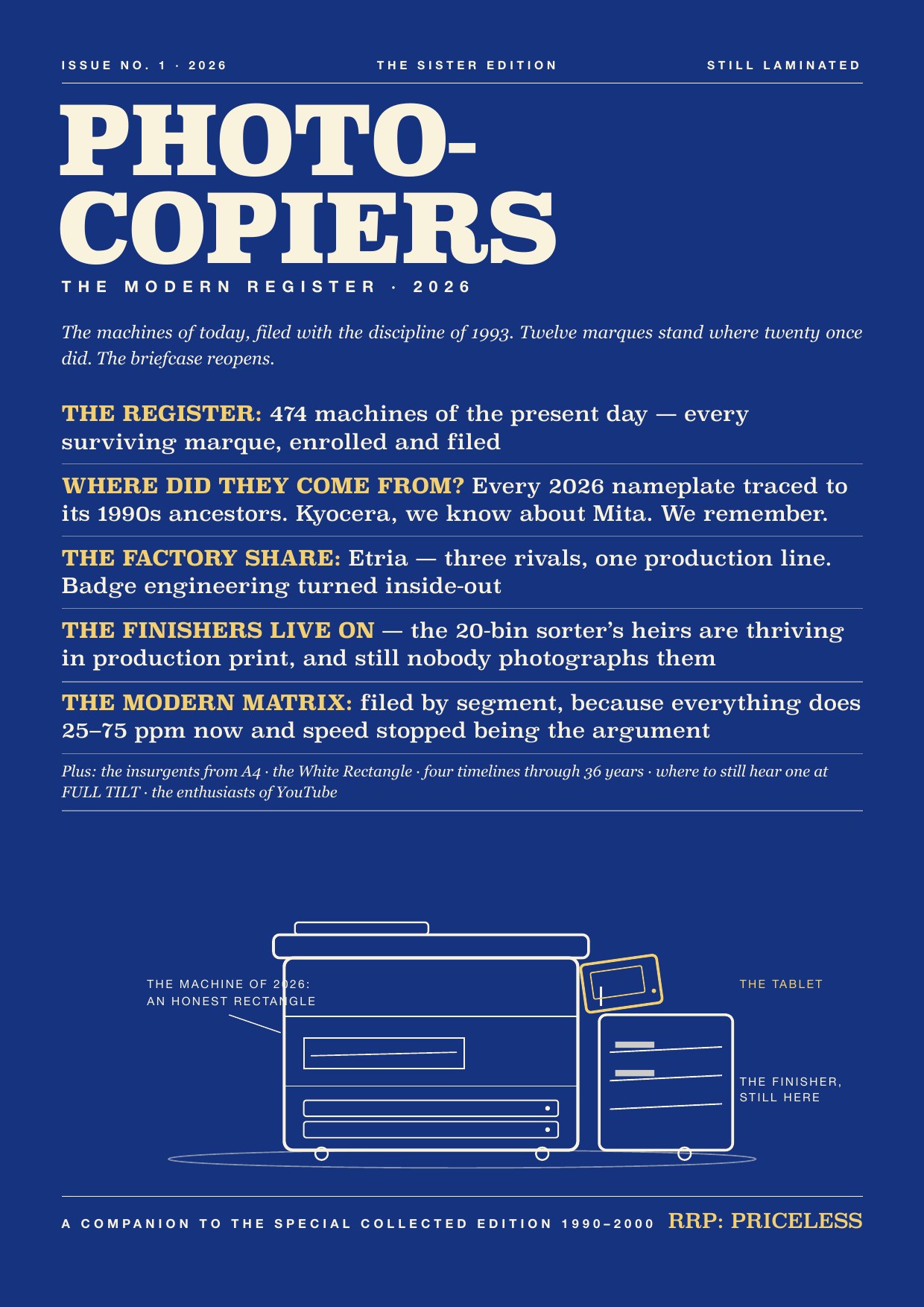
Last time, I told you about the briefcase: the teenage brochure archive, filed alphabetically by marque and ascending by copies-per-minute, with a red magazine in protective plastic at the front — and how the whole collection went to the bin after my final exams, and how, thirty years later, I rebuilt it as a 409-machine public archive and a seventy-five-page magazine.
That project had a loose thread, and the thread would not stop dangling. The red edition ended with an elegy called Where Are They Now? — a few pages on what became of the industry after 2000. A few pages, it turns out, were not enough. If you spend your adolescence memorising a market, you want to know how the story ends. So I asked the research department for a sequel.
The answer is now live: PHOTOCOPIERS: The Modern Register — the sister edition. The machines of 2026, filed with the discipline of 1993.
What happened to everybody
The short version: of the twenty-odd nameplates a diligent teenager could collect in 1993, every single one died, merged, or was absorbed into nine corporate survivors. Mita went bankrupt and was rescued by a ceramics company; the descendants of my most-thumbed brochures now ship wearing Kyocera TASKalfa badges. Konica and Minolta — two dividers in the briefcase — became one word. Fuji Xerox divorced after fifty-seven years, and Fujifilm is now selling copiers under its own name in Europe and America for the first time ever, a debut at sixty. Xerox nearly died, recovered, and in 2025 bought Lexmark. And three gatecrashers — HP, Epson, Brother — forced their way into a market they’d sensibly avoided the first time round.
Also: nobody makes photocopiers. The category quietly dissolved around 2004 into “multifunction devices” and “document solutions”. The magazine keeps the word PHOTOCOPIERS on the masthead anyway. Someone has to.
Why blue
The red edition is a recreation of a specific lost object — its red is period truth, and originals are not repeated. The sequel is a new publication, so it prints in royal blue: same cream stock, same typefaces, same filing religion, different ink. On the shelf they read as a two-volume set, which is exactly what they are.
The filing itself had to change, and this was the most honest editorial decision in the issue. In 1993 you filed by speed, because speed was the argument — the brochure’s first number, the salesman’s opening line. In 2026 everything mid-office runs 25 to 75 pages a minute and nobody leads with it. So the Modern Register files by segment: the insurgents’ A4 drawer, three A3-colour bands, the mono drawer (still, wonderfully, the largest in the cabinet), and the production annexe, where all the excitement went.
The sound trilogy
The strangest discovery of the project became three linked features. The industry spent thirty years engineering the noise out of these machines — softer tray landings, dampened fusers, quieter drums — and succeeded so thoroughly that the sound of a copier at full tilt is now functionally extinct as a public experience. The register went looking. Every museum that preserves working print machinery preserves letterpress; the Smithsonian’s Xerox 914 sits behind glass, silent. Nobody on earth keeps a working photocopier the way the print trade keeps a Heidelberg platen. The working-photocopier museum does not exist. The register is, for the record, accepting nominations.
Meanwhile, on YouTube, a print-shop owner named Dan films his production presses jamming and being fixed for forty-one thousand subscribers, and ten-hour loops of anonymous copier noise rack up millions of plays from people who use them to fall asleep. Thirty years of engineering went into taking the sound out; the internet has spent the last ten patiently piping it back in at bedtime. The most-replayed copier recording on earth carries no badge, no model number and no spec sheet — and the register, which names four hundred and seventy-four machines, finds that oddly hard to leave alone. The sound was never noise. It was the sound of things getting done.
The corrections desk never closes
Since the archive went public, its submission model has started working in the best possible way: the filmography’s “unidentified beige console” in Gremlins 2 has been identified — a Xerox 1090, recognised in footage preserved by the Xerox Nostalgia archive. A star has been restored. This is what archives are for.
And one last thing, which I promise I did not engineer. When the print run came due — both editions, A4, covers on card stock, laminated, obviously — I checked which machine would be doing the printing. It’s a Brother colour laser, an L8-series: one of the Modern Register’s own Insurgents, reviewed on page 27 of the very magazine it printed. The A4 swarm that ended the copier era, manufacturing the copier era’s memorial, in duplicate.
The briefcase would understand. Both registers are open.